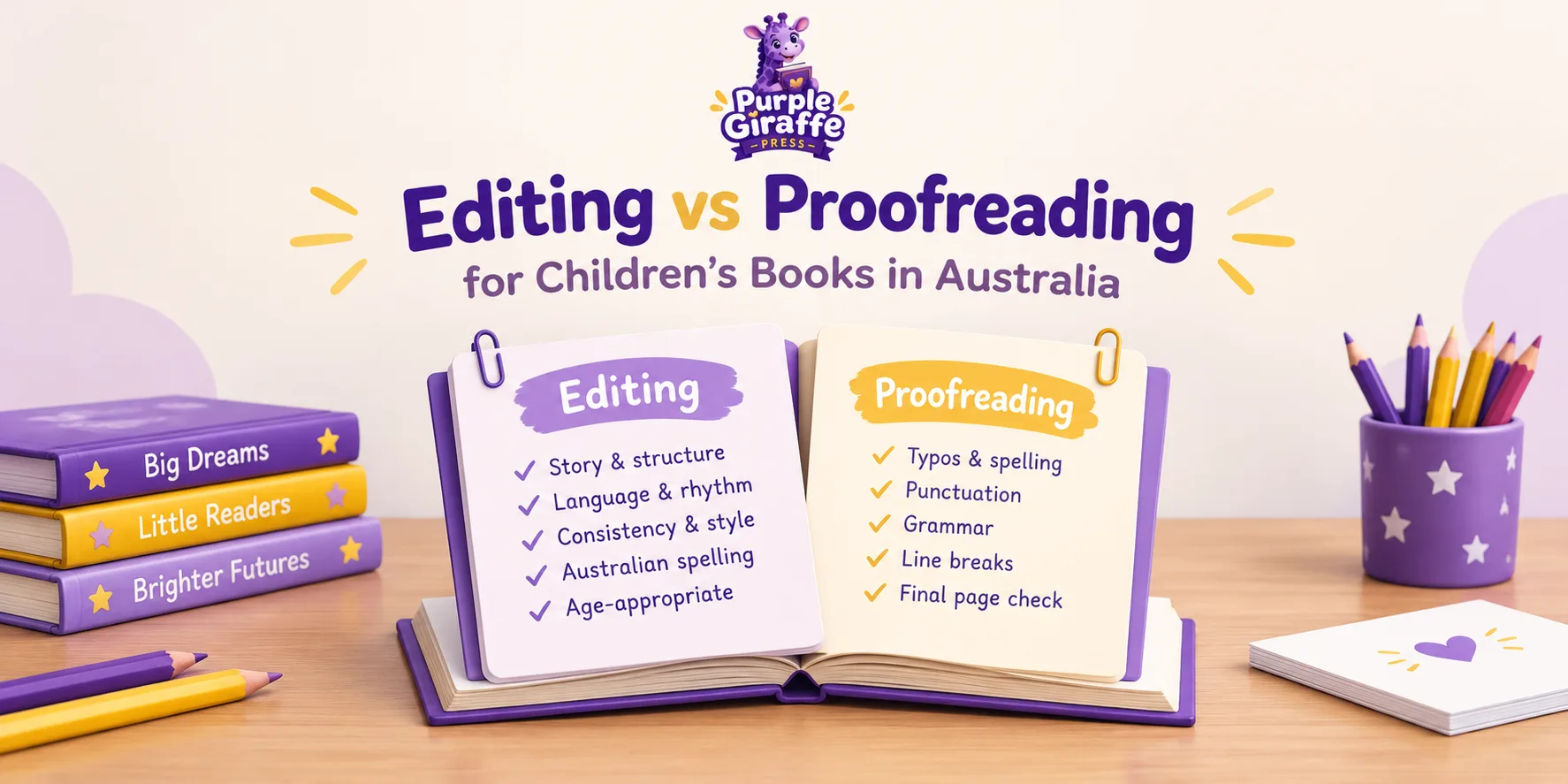
Editing improves the story, language and consistency of a children's book. Proofreading is the final check for errors on the finished pages. Editing comes first, and proofreading comes last, and a book that skips either one reaches readers with problems that a child, a parent, or a reviewer will notice.
Here's the situation most authors are in. You've got a picture book text of a few hundred words, a layout starting to take shape, and a nagging question: is a spell check and a careful read-through enough? It's a fair question, because short books feel easy to get right. They aren't. Fewer words means every word, every page turn, and every line break is exposed.
This guide covers the difference between the two services, the order the stages run in, what each one checks, a step-by-step proofreading method, a checklist for page proofs and printed proofs, and the Australian details most guides skip: spelling choices, national editing standards, legal deposit and cultural protocols. If you're still mapping the wider journey from manuscript to bookshelf, the book publishing process is a useful companion to this guide.
What Is the Difference Between Editing and Proofreading for Children's Books?
Editing improves the manuscript itself: story, structure, language, rhythm, and consistency. Proofreading is the last check on the finished, laid-out pages for typos, punctuation, spelling, and layout slips, without changing the writing. Editing shapes the book; proofreading protects it. They are separate jobs, usually done by different people at different times.
Editing is really a set of levels. At the top sits structural or developmental editing, which asks whether the story or message works. Below that is line editing, which works on sentences and sound, and copyediting, which tidies grammar, consistency, and style. Proofreading is the final level. Australian editing standards, published by the Institute of Professional Editors (IPEd), treat these as related levels of work rather than a rigid ladder, and that matches how most editors actually work.
Take a picture book as the example, because it shows the split most clearly. A picture book has a small text, a fixed number of pages, and an illustrator working alongside the author. That combination means there are two very different kinds of problems to find: problems in the telling, and problems in the finishing. Editing handles the first kind. Proofreading handles the second.
The most common mix-up is booking the wrong service for the stage. Authors send a text for a proofread when the ending still isn't landing, or ask an editor to "just have a quick look" at a book that's already been laid out. Either way, the wrong skill gets applied at the wrong time.
Table 1: Editing and proofreading for children's books at a glance
Editing | Proofreading | |
Main purpose | Make the story and language work for the child and the adult reading aloud | Catch what slipped through on the final pages before printing |
What it looks at | Plot or message, structure, age fit, word choice, rhythm, rhyme, consistency, grammar, Australian spelling and style | Typos, spelling, punctuation, repeated or missing words, line breaks, page numbers, text placed on or beside art |
Does it change the writing? | Yes, sometimes substantially | No, only corrects clear errors and raises queries |
When it happens | On the manuscript, before illustration is locked and before layout | On page proofs after layout, and on the printed proof |
What it works from | The manuscript, plus sketches or roughs if available | The laid-out pages, checked against the final edited text |
Typical result | A stronger text, tracked changes, an editorial letter or report | A marked-up list of corrections and queries |
Risk if skipped | Weak pacing, unclear age fit, clumsy read-aloud, inconsistent style | Visible errors in print that can't be corrected once copies exist |
Picture book example | Cutting a line the illustration already shows; fixing a stumbling rhyme | Spotting "the" repeated across a page turn; a character's name spelt two ways |
Read the last two rows together, and the split becomes obvious. An editor fixes the rhyme that stumbles when it's read aloud. A proofreader catches the name that's spelt two ways. Neither can do the other's job well. Imagine a text where a hedgehog is called Hattie on page four and Hatty on page nine. An editor working on the manuscript should catch it, and a copyeditor certainly will, but a proofreader is the last safety net if it somehow appears in the typeset pages. Overlap like this is normal, and it's a good reason to have more than one set of eyes on a book. Children's books raise the stakes on both jobs, which is what the next section explains.
Why Do Children's Books Need a Different Approach From Adult Manuscripts?
Children's books are usually read aloud by an adult, shared across pages with illustrations, and kept very short, so each word, page turn, and line break carries more weight than in a longer adult book. A picture book is often a few hundred words, which means one weak word or one typo is easy to see.
There are two readers to satisfy. The child listens and looks. The adult reads aloud, often night after night, and notices every stumble. A sentence that looks fine on the page can trip the tongue at bedtime, and a typo that survives into print becomes something a parent points at, a teacher mentions, or a reviewer quotes.
Length changes the arithmetic too. A standard picture book format is commonly described as 32 pages, and well-known Australian advice suggests keeping the text well under 500 words. Treat that as common guidance rather than a rule, but it shows how little room there is in a text that short; one clumsy line is a large share of the book.
Words and pictures also share the job. A line that describes a red umbrella is wasted if the illustration shows one clearly. Editing has to account for what the art says, and proofreading has to account for where the words sit on the page, whether they're readable over an image and where the page turn falls.
Think about how a typical picture book gets used. It's read at bedtime, in a classroom, in a library story session, and in a waiting room, often by someone who's never seen it before. That first cold read-aloud is the real test of the text. If the rhythm trips a stranger, the book has a problem that no amount of beautiful illustration will hide.
Then there's sound. Rhythm, repetition and rhyme belong to the editing brief, not to some optional extra. And vocabulary and sentence length have to suit the age band, which is a judgement that comes from working with young readers, not from adult-trained instincts alone. A word that's perfectly ordinary to an adult can stop a five-year-old cold, while a long but familiar word, such as "kangaroo", sails through. Specialist children's editors develop a feel for that difference over many books.
The age band shifts the emphasis of an edit, too. For the youngest listeners, such as toddlers, the focus is sound, repetition and very simple sentences. For picture books aimed at preschool and early primary children, pacing, page turns, and the interplay with art take centre stage. Early readers, who are starting to decode words themselves, need sentence length and vocabulary that support independent reading. Chapter books bring back plot, character and structure much as an adult novel would. Naming your age band before you hire anyone helps an editor aim at the right target.
What Order Do the Editing and Proofreading Stages Run in for a Children's Book?
The usual order is a manuscript assessment or structural edit, a line edit, a copyedit, then illustration and layout, followed by a proofread of the page proofs and a check of the printed proof. Proofreading always comes after layout, because typesetting and design can introduce new errors that no earlier stage could catch.
Here's the sequence in practice:
Self-edit and read-aloud pass. You do the first clean-up yourself (more on this in the self-editing section).
Manuscript assessment or structural edit. Is the story or message working for the intended age?
Line edit. Sentences, word economy, rhythm and rhyme.
Copyedit. Grammar, consistency, Australian spelling and a style sheet.
Illustration and layout. Final art can change what the text needs, so it helps to know how to choose a children's book illustrator in Australia before this step begins.
Proofread of page proofs. Text and layout together.
Printed proof check. Final approval for print.
The logic is simple. Every change risks introducing a new error, so the later the change, the more careful the check that follows it. If you ask for a wording change after proofreading, the affected pages need to be proofread again. That's why experienced editors push hard to settle the text before layout begins.
Not every book passes through every stage, and the stages overlap. A copyeditor will often fix small errors as they go, and a proofreader may raise a query about meaning. The goal isn't to enforce a rigid ladder. It's to know which job is the main one at each point, so the right person is looking for the right problems.
There's one more wrinkle for illustrated books. In a picture book, the illustrator's roughs and the author's text often evolve together. A page that seemed to need two sentences may need one once the sketch comes in, or the art may add a joke the words no longer need to make. That's why structural and line edits benefit from seeing the roughs if they exist, and why final copyediting usually waits until the artwork is close to settled. Editing the text in isolation and then discovering the pictures disagree is one of the most common sources of late changes.
Consider an invented example. An author finishes a rhyming picture book about a wombat who won't go to bed. She sends it for a proofread, and the proofreader (rightly) corrects three commas and a misspelt word, but can't fix the fact that the third verse limps. That's a line edit problem. A proofread can't repair it, and the verse goes to print with the limp intact. The stage order exists to stop exactly that.
What Does Editing a Children's Book Involve?
Editing a children's book covers the story or message, the sentences, the sound, the Australian spelling and style, and, where needed, a cultural or fact check. Each level has a different job, so name which one you need rather than asking for "an edit".
Structural or developmental editing
This is the big-picture read. Does the story have a clear central character, a problem that matters to a child, and an ending that feels earned? Is the message woven into the story or bolted on at the end? Does the book fit its intended age band? It helps to understand where your book sits among children's book genres, because a text that wobbles between a board-book voice and a chapter-book voice confuses everyone.
A structural editor will also test whether the character carrying the story is the one the reader cares about. The distinction between a protagonist vs main character sounds academic until a story's narrator, hero, and emotional centre turn out to be three different animals.
What comes back from a structural edit is usually an editorial letter or report rather than a marked-up manuscript. It explains what's working, what isn't and why, and it leaves the rewriting to you. Expect to revise, and expect that revision to change the text noticeably. That's normal, and it's far easier to do now than after the book has been illustrated and laid out. Many authors find the report more valuable than any single correction, because it teaches them to see their own drafts differently.
Line editing
Line editing works sentence by sentence. The aim is word economy, vivid but simple language, and rhythm that reads aloud smoothly. It also means asking whether imagery in a children's book is doing real work or just decorating. A line editor will often cut a description the illustration will carry and sharpen the verbs that are left.
Rhyme deserves special attention. Rhyming text is held together by metre, which is the pattern of stressed and unstressed beats, and a line that is one beat short or long jars when it's read aloud even if the rhyme itself is perfect. A line editor reads rhyming text the way a musician reads a bar of music, tapping out the beats and flagging where a reader will have to rush or stall. Forced rhymes are the other classic problem: a word chosen only because it rhymes, which bends the meaning or the grammar out of shape. The fix is usually to rewrite the line, not to swap the word.
Here's a small invented before and after. The draft reads: "The big, round, shiny, orange sun slowly came up over the hills." After a line edit: "The sun climbed the hills." One short sentence now leaves the artwork room to show the rest.
Copyediting
Copyediting cleans up grammar, punctuation and consistency: character names, tense, numbers, capitalisation, and the way things like "okay" or "Mum" are written throughout. It also settles Australian spelling, which generally follows British spelling with some exceptions. The Australian Government Style Manual advises choosing one Australian English dictionary and applying it consistently, and recording decisions on a style sheet. That's written for government, but it's a sound model for any book.
Vocabulary is part of the copyedit too. A copyeditor with children's experience checks that the words and sentence lengths suit the intended age band, and queries anything that might be unclear to the youngest listeners. They'll also check for internal consistency: if the story says the wombat has three friends on page two, the count had better hold on page twelve.
A copyeditor also catches the confusable pairs that spell checkers wave through. A good example is the question of ingrained vs engrained, where both forms turn up in print and consistency matters more than guesswork.
Cultural and sensitivity review
This is a separate, specialist read, and it isn't a proofreading task. If your book draws on First Nations stories, language or imagery, the Australia Council for the Arts released its Protocols for using First Nations Cultural and Intellectual Property in the Arts in 2020, written by Dr Terri Janke. The protocols set out principles that include communication, consultation and consent. An editor can flag concerns, but an editor does not replace consultation with the relevant community. The same read is useful for representation more broadly and for the age-appropriate handling of difficult topics.
Fact checking for non-fiction picture books
If your book teaches something, such as animals, history or science, every name, date, species and place needs verifying before the copyedit is locked. The differences between fiction vs non-fiction matter here, because an error of fact is harder to live with than a typo. If you'd like experienced eyes on any of these levels, our professional children's book editing covers each one.
What Does Proofreading a Children's Book Involve?
Proofreading a children's book is a final read of the laid-out pages against the edited text, looking for typos, repeated or missing words, punctuation slips, inconsistent names, poor line breaks, and text problems around the artwork. A proofreader corrects errors and raises queries. They don't rewrite the story.
The checklist is practical and specific. A proofreader looks at spelling and punctuation, capitalisation, and repeated words that hide at line or page breaks. They check hyphenation and word breaks, confirm that names and numbers match the edited text, and verify running heads and page numbers. They also look at captions and credits, the front matter (title page, copyright page and dedication) and the back-cover text.
Just as important is what a proofreader doesn't do. They don't restructure the story, change the voice, rework a rhyme, or fix a weak ending. If a proofreader spots something deeper, such as a sentence that seems to contradict an illustration, the right response is a query, and the author or editor decides what to do. A query might read something like: "Page 14 text says the boat is blue, but the illustration shows a red boat. Please confirm which is correct." That's a proofreader doing exactly the right thing, noticing the problem and handing the decision back. The author or illustrator can then fix the text, the art, or neither, and the proofreader doesn't have to guess. Proofreaders typically return a marked-up copy plus a short list of queries, so you can see every change and every question in one place.
That boundary protects both sides. The author keeps control of the writing, and the proofreader stays focused on finding what's wrong rather than improving what's there.
Picture books raise the pressure. Short text means errors stand out, and layout can split a sentence awkwardly across a page turn so a reader sees half a thought. A proofreader who understands illustrated books will read each spread as the child will meet it, not just as a block of text. When you're ready for that final check, a professional proofreading service built around illustrated books is the right fit. The next section gives you the method.
How Do You Proofread a Children's Book Before Print?
Proofread in separate passes on the final layout: lock the text, step away, read at actual size, read aloud, check one type of error at a time, then check every spread against the illustrations and the edited text. Finish with the cover, spine, and back-cover text, and have a second person read it too.
Lock the text. Confirm which version is final and keep a copy of the edited text to compare against. If the text is still changing, you're not ready to proofread.
Take a break. A few days is better than an hour. The aim is to make familiar words look unfamiliar.
View at actual size. Look at pages at 100 per cent, or print at actual scale. "Fit to page" settings change the type size and can hide problems.
Read aloud once for sense, then slowly for letters. The first pass catches stumbles. The second, slower pass catches the missing "s".
Do separate passes. One for spelling, one for punctuation, one for names and numbers. Your eyes miss more when they're hunting for everything at once.
Read each spread as the child will see it. Check that words and images don't contradict each other, and that nothing important is hidden in the fold.
Check the cover last. Read the front cover, spine, blurb, barcode area, and copyright page, and confirm that author and illustrator names are spelt identically everywhere. Our guide to book cover design explains why the cover needs its own pass.
Ask a second reader to go through it cold. Someone who hasn't seen the text will see what you can't.
A quick word about tools. A spell checker won't catch a correctly spelt wrong word, like "form" for "from" or "there" for "their". Grammar tools, including those that use artificial intelligence, can help as a first filter, but they can't judge page turns, text sitting on artwork or whether a rhyme still scans. They can also suggest changes that break the rhythm or swap Australian spelling for another variant. Use them to catch the obvious, then do the real check yourself.
One test is worth doing on every spread. Cover the illustration and read only the words, then cover the words and look only at the picture. Then put them together. The words alone should still make sense, the picture alone should still be clear, and together they should say something slightly richer than either does on its own. If the text describes something the art contradicts, or repeats something the art already shows, flag it. That check often turns up problems that no line-by-line read will find.
Here's a habit worth borrowing from working proofreaders. Keep a short list of your own recurring errors. Many authors consistently mix up the same two or three things, and knowing yours turns a vague search into a targeted one.
What Should You Check on Page Proofs and Printed Proofs of a Picture Book?
On page proofs, check text placement, page turns, spreads, margins near the fold, and legibility over artwork. On a printed proof, check trim size, colour, image sharpness, bleed, spine, and the text near the gutter. Order a printed proof from the printer you plan to use, because results differ between printers.
Page proofs (digital) show you the layout before anything is printed. Look at whether text over artwork is readable, whether anything sits too close to the trim or the fold, and whether page turns land where the story needs them. Check that spreads read in the right order and that fonts and sizes are consistent. Layout problems often begin in the files, so if you spot a pattern, talk to whoever handles your book formatting. It also helps to understand how children's book illustration works with text, because the two have to be judged together.
Printed proofs (physical) show what paper does to your files. Check the trim size and cover alignment, the spine text, and whether colours look right. Printed colour often looks different from the screen, so a vivid illustration can appear flatter or darker. Look at image sharpness, and watch for white slivers where artwork should run to the edge of the page. Open the book flat and check the text near the gutter, where words can vanish into the binding. Bleed and trim requirements vary between printers, so confirm them with yours rather than assuming one standard. When you reach this stage, children's book printing is where those details get settled.
Page turns deserve their own mention. In a picture book, the turn of the page is a storytelling tool: it creates suspense, delivers a surprise, or gives a pause. A sentence that ends just before the turn builds anticipation, whereas one that splits across the turn can feel like a stumble. During page proofs, flip through the book slowly, turn by turn, and ask whether each turn lands where the story wants a beat. If it doesn't, the fix might be a small layout adjustment or a tiny trim to the text, but it has to be decided before the files go to print.
When do you need a new proof? Any time something moves. If text reflows, images change, fonts change, or the page count shifts, check again. A one-for-one word swap of a similar length can often be checked digitally. And if the art changes late, the text placement has to be rechecked, which is one reason authors working with custom illustrations should build in time for a final look.
Image-heavy books often need more than one proof round, because every adjustment can shift something else. Plan for that rather than hoping to get it right the first time.
Which Do Australian Authors Need: Editing, Proofreading or Both?
Most children's books need both. Choose editing when the text can still change, and proofreading when the text and layout are final. A picture book going to print without either is taking a risk that's hard to reverse, because printed copies can't be corrected.
Where are you now, and what should you book next?
Where you are | What you need next | Why |
First draft; unsure the story works | Manuscript assessment or structural edit | Fixing structure early saves rework at every later stage |
Story settled; language feels rough or clunky | Line edit, then copyedit | Tightens wording and rhythm before illustration locks the text in place |
Rhyming picture book text | Line edit focused on metre and read-aloud flow, then copyedit | Rhyme problems are rhythm problems, which proofreading can't solve |
Non-fiction picture book | Fact-check, copyedit and proofread | Errors of fact are harder to correct after print than typos |
Content involving First Nations stories or culture | Consultation and cultural review before the final copyedit | This sits outside what an editor or proofreader can decide alone |
Edited text, layout finished | Proofread of page proofs | Layout introduces errors earlier stages couldn't see |
Laid-out files approved, ready for print | Printed proof check | Colour, trim, spine and gutter problems only show on paper |
Small change after approval | Targeted re-proof of the affected pages | Late edits are a common source of new errors |
Traditionally published | Check what your publisher provides before booking anything | Editorial and proofreading steps are normally handled in-house |
If you're self-publishing, you're the project manager, so the table works as your schedule. Work down it in order and don't jump to the later rows early. If you're considering a middle path, hybrid publishing for children's books sits between the two, and it's worth confirming exactly which editorial stages are included before you sign anything.
Two quick scenarios show how this plays out. An author with a finished rhyming text and no illustrations yet should book a line edit and copyedit now, and leave proofreading until the layout exists. An author whose illustrated files are done and who has only ever self-checked the text should go straight to a proofread, but should also ask whether the text itself has had a proper edit, because a proofread won't reveal that gap.
If you're traditionally published, the situation is different. The publisher normally arranges editing and proofreading, though it's still sensible to ask which stages your contract covers and whether you'll see page proofs.
One last point. Good editing doesn't remove the need for proofreading, and proofreading never replaces editing. A beautifully edited book can still go to print with a layout slip, and a flawless proofread of a weak story is still a weak story.
Can You Edit and Proofread Your Own Children's Book?
You can and should do a thorough self-edit first, but you can't reliably proofread your own book because you read what you meant to write. Self-editing reduces the work a professional has to do. It doesn't replace a fresh set of eyes on the final pages.
There's plenty you can do yourself. Read the text aloud several times, and record yourself so you can listen back. Test it on children and adults and watch where they get restless or stumble. Cut words that the illustration will cover, check names and facts, and start a style sheet that records spelling and punctuation choices.
Why do authors miss errors in their own work? Familiarity. Your brain fills in what it expects, so the missing word never registers. Fresh-eyes tricks help: leave the text for a week, change the font, or read the pages in reverse order so the story's momentum can't carry you past mistakes.
A simple routine helps. Spend the first day on structure: can you say what the story is about in one sentence? On the second, read it aloud and mark every place you stumble. On the third, cut anything the pictures will show. On the fourth, check names, facts, and spelling against your style sheet. Then leave it alone for at least a week before you look again. That break does more for your own proofreading than any checklist.
Beta readers and child readers are valuable too, but for a different reason. They tell you how the story lands and whether the age fit is right. They're not a substitute for technical correction, and it's unfair to expect them to catch typos.
Sometimes the real problem isn't polishing a draft but getting one written. If that's where you are, working with a ghostwriting team, or a fiction ghostwriting specialist for story-led picture books, can get you to a manuscript worth editing. Once you have it, the self-editing steps above apply just the same.
How Do You Choose a Children's Book Editor or Proofreader in Australia?
Look for an editor or proofreader with children's book experience, ideally with picture books, who works in Australian English, will do a short sample, and confirms in writing which stage they're providing. Membership of a recognised editors' body is a useful signal, not a guarantee.
Experience. Ask what picture books they've worked on, whether they've handled rhyming text, and how they approach the relationship between words and illustration. A novel editor and a picture book editor use different muscles.
Questions to ask. A few questions reveal a lot. How do you handle rhyming text? Do you work from the manuscript, the layout, or both? What do you do when you notice a problem that's outside your stage? How do you record spelling decisions? The answers show whether someone has real experience with illustrated children's books or is applying a generic process.
Preparation. Before you contact anyone, gather the basics: your word count, the intended age band, what stage the book is at, whether the illustrations are final, and whether you've started a style sheet. A professional can scope the work far more accurately when they know these details, and you'll avoid the back-and-forth that comes from guessing.
Standards and membership. The Institute of Professional Editors (IPEd) represents Australian editing societies and publishes the national standards for editing practice, with the third edition released in 2024. Membership or accreditation is a useful signal. Check the current details on the IPEd site rather than relying on a profile page.
A sample. A short sample edit or proofread shows how someone actually works. Ask what comes back: tracked changes, a style sheet, a report, or a list of queries. The format tells you whether their process matches what you need.
Scope in writing. Which stage are they providing? What's included? How many rounds of review? How are late changes handled? Who owns the final files? Vague answers here lead to disagreements later.
Australian English. Confirm which dictionary they'll follow and that they'll record decisions on a style sheet, so spelling stays consistent from first page to last.
Red flags. Be wary of anyone who guarantees publication or sales, who offers to do every stage themselves including the final proof with no fresh eyes, who won't provide a sample, or who can't explain their process. A confident professional is happy to explain what they do and what they don't.
What Australian Publishing Steps Come After the Final Proof?
After the final proof, lock the files, approve the print order, and complete your Australian publishing obligations. Anyone who publishes a book in Australia, whether free or for sale, is generally expected to give one copy to the National Library of Australia and one to their state or territory library under legal deposit.
Legal deposit applies to independently published books, and you don't need an ISBN for it. National Library's National edeposit service can satisfy both the national and state or territory obligations at once. Check the National Library's current guidance before you publish, as details can change.
Legal deposit is easy to overlook because it comes at the end, when the excitement is about the finished book. It's worth putting on your schedule early, so the final step doesn't get forgotten. It also means a copy of your book, errors and all, goes into the national collection, which is one more reason to get the proofing right.
Before you approve the print order, run a short final check. Confirm that the files you're approving are the ones that were proofread. Check that every correction from the proofread was made and not just noted. Read the copyright page and cover one last time, since those are the places where last-minute errors tend to hide. Make sure the author and illustrator credits are exactly as you want them to appear.
Keep a clean record of your final, corrected files. When you reprint, you'll want the version that includes every correction, not an earlier one.
Then the book needs readers. That's where book promotion comes in, along with author websites, where a sample spread can show families what the book feels like. If you plan an audio version, audiobooks should be recorded from the final text only, so narration never captures an error you've since corrected.
Ready to Get Your Children's Book Edited and Proofread?
The next step is a short conversation about your manuscript, where it is now and what you're planning, so the right stages can be matched to your book. At Purple Giraffe Press, we work with Australian authors on children's books from first draft to finished copy, and we're happy to talk through what yours needs. Tell us your age band, your stage and whether the artwork is final.
Get in touch with Purple Giraffe Press to request a written quote for editing and proofreading. You'll finish with a clear view of the stages ahead, and a book that reaches its young readers the way you meant it to.
Ready when you are
Let's bring your children's book to life.
From a first idea to a finished book children adore, we are with you at every step. Tell us about your story and we'll reply within one business day.
Start Publishing →