You've finished your manuscript. You've read it aloud, tightened every sentence, and you finally believe in the story. Now comes the part that trips up almost every self-publishing author: finding the right illustrator.
It's a bigger decision than most first-time authors expect. The illustrations in a children's book aren't decoration sitting around your words. They carry half the story, set the emotional tone, and are usually the reason a child begs for "one more read" at bedtime. Get the illustrator right, and your book comes alive. Get it wrong, and even a beautifully written manuscript can end up looking amateurish on the shelf.
The trouble is, Australia's illustration market is scattered across marketplaces, freelance sites, Instagram feeds and agencies, with talent ranging from award winning professionals to hobbyists using AI tools to fake a portfolio overnight. How do you tell the difference? How do you know if someone actually understands the technical demands of a printed picture book, not just a pretty digital image? And how do you avoid paying real money for artwork that falls apart the moment it hits the page?
This guide walks you through the whole process: matching illustration styles to your book's age group, where Australian authors actually find illustrators, how to evaluate a portfolio like an art director would, the questions worth asking before you sign anything, realistic budgeting in Australian dollars, and what a proper contract needs to cover. We've also included a downloadable illustrator brief template and a checklist for spotting AI-generated art, because both of those problems catch out first-time authors constantly. By the end, you'll know exactly how to choose a visual storyteller who will do your manuscript justice.
If you're still polishing the manuscript itself before you even think about illustrators, it's worth reading our guide on how to write a children's book first. A clear, well-structured story makes the illustrator's job (and yours) far easier.
Understanding Illustration Styles and Matching Them to Your Book
Before you open a single portfolio, work out what you're actually looking for. Children's book illustration isn't one style stretched across every age group. A board book for a one year old needs bold, simple shapes with high contrast. A middle grade novel can carry detail, nuance and even a moodier palette. Match the wrong style to the wrong audience and the book will feel off, even if the art itself is lovely.
Cartoon and Whimsical
Best suited to humorous picture books and early readers. Exaggerated features, bright colour, playful expressions. Think of the loose, energetic style used across Aaron Blabey's Pig the Pug and The Bad Guys series, work that's instantly recognisable to Australian kids and built entirely around comic timing.
Realistic and Painterly
Suited to stories with emotional weight, nature themes or a quieter, more literary tone. Detailed rendering, natural proportions, often traditional media like watercolour or gouache. Freya Blackwood's illustrations for Fox and Harry & Hopper sit firmly in this space, soft and observational rather than cartoonish.
Watercolour and Soft
Best for bedtime stories and gentle narratives about feelings. Washes of colour, soft edges, a dreamy, unhurried atmosphere. Anna Walker's work is a good Australian reference point here, quiet and tender without being saccharine.
Digital and Graphic
Suited to modern, action-driven stories and graphic novel hybrids for older children. Clean lines, bold colour, often flat design or comic-style panelling. Jonathan Bentley's more contemporary digital pieces sit in this territory, energetic without losing warmth.
Collage and Mixed Media
Good for concept books and quirky stories that want a handmade, tactile feel. Paper, texture, found materials, highly layered compositions. If you want a picture book that feels crafted rather than screen-perfect, this is the style to search for.
Expert tip: match the style to your book's age group first, your personal taste second. Board books need simple, high-contrast images a baby can actually focus on. Picture books for ages three to eight can carry more complexity, but the art still has to read clearly from across a room. Middle grade and chapter books can handle nuance and subtlety that would be lost on a toddler.
Aligning Style With Tone
Action or adventure: dynamic compositions, strong diagonals, a real sense of movement.
Quiet or emotional: illustrators who are strong on facial expression, body language and atmospheric light.
Funny: a gift for visual comedy, exaggerated reactions, background gags, and comic timing on the page.
Educational or non-fiction: clear, accurate, engaging work, often with diagrams or labelled illustrations.
Here's the shift in thinking that separates a good hiring decision from a lucky one: treat the illustrator as a co-author, not a hired hand. The best illustrators add visual subtext that isn't written anywhere in the manuscript. A character's favourite toy might turn up in the background of every spread. A secondary character might have a whole silent storyline told only in pictures. When you're reviewing portfolios, look for that extra storytelling layer. It's the difference between a book a child reads once and a book they beg to have read again, because they keep noticing something new.
If you'd like more detail on the visual side of your book specifically, our piece on how to design a children's book cover covers the same style-matching principles applied to your most important single image.
Where to Find Children's Book Illustrators in Australia
Different platforms attract different kinds of illustrators, and each comes with its own trade-offs. Here's a realistic directory to start your search.
Curated Marketplaces
Reedsy is a marketplace of vetted, professional illustrators with detailed profiles, reviews and portfolio browsing. It's a solid starting point if you want an experienced professional and a structured process, though the price point sits mid-range to premium and it's less suited to very tight budgets.
Freelance Platforms
Fiverr and Upwork offer a huge range of illustrators at every skill level and price point. You can find genuine budget-friendly finds, but quality varies enormously and you'll need to vet carefully. Filter for top-rated sellers, read recent reviews, and look for illustrators who show process sketches rather than only polished final pieces. That's one of the clearest signals of a real, professional workflow.
Portfolio Sites
Behance and Dribbble let illustrators showcase full projects rather than isolated images. You can search by keyword, "children's book illustrator" or "kidlit art" work well, and often discover artists who aren't listed on marketplaces at all. There's no built-in vetting, so you'll be reaching out and negotiating cold.
Social Media
Instagram remains a genuinely useful place to search hashtags like #childrensbookillustrator, #kidlitart or #picturebookillustration to find active Australian artists. Look for creators who post work-in-progress shots and character turnarounds, not just finished art. That habit shows they understand the iterative nature of book illustration, and it's harder to fake than a polished feed.
Professional Organisations
Illustrators Australia runs a searchable member directory that lets you browse professional, establishing and student illustrators by style and medium, with many members experienced specifically in children's publishing. The Australian Society of Authors (ASA) is also worth knowing about here, not as a place to browse portfolios, but because it publishes benchmarked, regularly reviewed rates of pay for book illustration that are genuinely useful when you're working out whether a quote is fair.
Agencies
Illustration agencies represent a roster of artists and handle contracts, negotiation and sometimes art direction. You get access to top-tier talent and someone else managing the business side, but it's the highest cost tier and you'll usually have less direct contact with the artist themselves.
Working With a Publishing Partner
If browsing dozens of portfolios and negotiating with strangers doesn't appeal, Purple Giraffe Press offers custom illustrations as part of our children's book publishing services, matching authors with illustrators experienced in Australian children's publishing and managing the brief, revisions and rights on your behalf.
How to Evaluate an Illustrator's Portfolio Like a Pro
Most authors look at a portfolio and think "I like this style." That's a start, but it's nowhere near enough. A beautiful style can hide serious technical flaws that will wreck your book once it's printed. Evaluate a portfolio the way an art director would, with a checklist that goes well past surface appeal.
Character consistency. Does the same character look identical from different angles, in different scenes, with different expressions? Check the eyes, the nose, the proportions. If they drift, you're looking at an illustrator who hasn't mastered consistency, and it will show throughout your book.
Composition across spreads. Does the illustrator understand how to compose for a double-page spread, with a clear focal point, good use of negative space, and a flow that carries the eye across the gutter? Be wary of portfolios where every image is a single centred character. That gets monotonous fast across a 32-page book.
Use of gutter and bleed. The gutter is the centre fold where pages meet. Does the illustrator avoid placing important elements, like a character's face, right in that fold? Bleed is art that extends to the edge of the page. Does the illustrator provide full-bleed images where appropriate, and understand that bleed means extra art beyond the trim line, not just a resized image?
Lighting and atmosphere. Does the illustrator use light to build mood, bright and cheerful in one spread, soft and dreamy in another, dramatic and shadowy where the story needs it? Flat, uniform lighting across every image tends to make a book feel lifeless.
Texture and depth. Even fully digital art benefits from texture, brushstrokes, paper grain, layered elements that add warmth. Flat, vector-style art can absolutely work for the right book, but it should read as a deliberate choice, not a shortcut.
White space for text. A children's book illustrator has to leave room for the words. Does the portfolio show spreads with calm, uncluttered areas where text could comfortably sit? If every image is packed edge to edge with detail, your text will be fighting for attention on every page.
Storytelling ability. Does the art tell a story on its own? Look for sequences that show cause and effect, emotional arcs, and that visual subtext we talked about earlier, a secondary character's reaction, a recurring motif, a small joke tucked into the background.
Print this checklist, or keep it open on your phone, while you review portfolios. It will save you from hiring someone whose work looks great on a screen but falls apart once it's laid out for print.
Expert tip: always ask to see a full book dummy or a sequence of spreads from a single project, not just a highlight reel of isolated "greatest hits." That reveals whether an illustrator can sustain quality and narrative flow across an entire book, which is a very different skill to producing one striking image.
Questions to Ask Before You Hire
Once you've shortlisted a few illustrators, it's time for a proper conversation. The right questions reveal whether someone is a genuine professional and the right fit for your particular project. Don't skip this step. A charming portfolio can still hide a difficult collaboration.
Experience and process: How many children's books have you illustrated from start to finish? Can I see samples of the final printed books? Walk me through your typical process from brief to final files. Do you have experience with print production, bleed, trim size, gutter and colour space (CMYK versus RGB)?
Timeline and availability: What's your current availability, and how long would a full 32-page picture book realistically take? Can you provide a schedule with milestones, character sketches, storyboard, roughs, final art?
Revisions and feedback: How many rounds of revisions are included in your fee? What counts as a revision versus a new request? How do you prefer to receive feedback, annotated PDFs, email, a call?
File delivery and formats: What file formats will you deliver, typically layered PSD or AI files plus high-resolution TIFF or PNG? Will the files be print-ready at 300 DPI, in CMYK, with bleed and trim marks?
Rights and usage: Are you selling full copyright or a licence? If it's a licence, what are the terms, territory, duration, media? Will I have the right to use the illustrations for marketing, merchandise or future editions?
AI usage guarantee: Do you use any AI tools in your process? Can you guarantee the artwork is entirely human-created? Are you willing to include an AI-usage clause in the contract?
Expert tip: ask for a paid sample or a single character sketch before committing to the full book. A small fee, somewhere between $75 and $200, for one character in a specific pose reveals compatibility, skill and communication style faster than any portfolio review ever will.
Illustration Costs and Budgeting in Australia
Money is usually the biggest source of anxiety for self-publishing authors, and understandably so. Knowing what actually drives cost will help you budget realistically, without either overpaying or falling for a suspiciously cheap deal that ends up ruining your book.
What Influences the Price
Experience and reputation: an illustrator with award nominations or a strong publishing track record will charge more.
Number of illustrations: a standard 32-page picture book typically needs 14 to 16 full spreads plus spot illustrations. Chapter books might run to 10 to 20 black-and-white interior pieces.
Complexity: detailed, full-colour scenes take considerably longer than simple line work.
Rights purchased: buying full copyright costs more than a limited licence.
Timeline: rushed turnarounds usually attract a premium.
Platform or agency fees: marketplaces and agents take a cut, which is often built into the quoted price.
The Australian Society of Authors publishes benchmarked rates of pay for book illustration, reviewed periodically to reflect the current market. As a reference point, the ASA's recommended rate for a full-page colour book illustration sits around $705 ex GST, though in practice many working Australian illustrators charge less than this due to competition from overseas freelancers, and some charge considerably more depending on experience. Treat ASA rates as a fair benchmark to negotiate from, not a fixed price.
Pricing Tiers for a Full 32-Page Picture Book
Tier | Price Range (Full Book, AUD) | Typical Illustrator | Pros | Cons |
Budget | $800 to $2,500 | Emerging artist, student, or freelancer found on Fiverr or Upwork; often limited book experience | Low upfront cost, occasional hidden gem | High risk of inconsistency, weak print knowledge, or AI-generated work; often no contract; limited revisions |
Mid-range | $3,000 to $6,000 | Experienced freelancer with several published books; often found via Illustrators Australia, Reedsy or Behance | Good balance of quality and cost, professional process, usually includes a contract | May still have gaps in print production knowledge |
Premium | $7,000 to $15,000 | Established illustrator with a strong portfolio and multiple published books, sometimes agency-represented | Consistent, high-quality art, strong grasp of print, collaborative process | Significant investment, may have a waiting list |
Elite | $15,000 to $30,000+ | Award-recognised, internationally published illustrator | Museum-quality art, adds real market value, full-service collaboration | Very high cost, long lead times, out of reach for most self-publishers |
Expert tip: for a first-time self-publisher, the mid-range tier is usually the sweet spot. You get a professional who genuinely understands the process without the premium price of a big-name illustrator. If your budget is tight, consider a hybrid approach, a premium illustrator for the cover and a mid-range artist for the interior spreads.
Budgeting Beyond the Illustration Fee
Paid sample or character sketch: $75 to $200
Cover design, if handled separately: $400 to $1,200
Book layout and typesetting: $300 to $1,000
ISBN and barcode: roughly $44 through Thorpe-Bowker for a single ISBN in Australia, with bundle pricing for multiples
Printing costs: varies widely by quantity, trim size and print run, and our children's book printing team can talk you through realistic print quotes once your files are final
Marketing and promotion: budget at least a few hundred dollars, and see the budgeting notes in our book promotion services for what that typically covers
These prices are current estimates only. Illustrator rates, printing costs and ISBN fees shift over time, so confirm current pricing directly with your chosen illustrator, printer and ISBN agency before locking in a budget.
Contracts and Rights: What Must Be Included
Never start a project without a written contract. A handshake deal or a loose email thread is a recipe for disaster. A proper contract protects both you and the illustrator, and it should cover every part of the collaboration.
Scope of work: exactly what the illustrator will deliver, number of illustrations, cover art, spot illustrations, character designs, and in what format. Include the book's trim size, page count and any technical specs.
Timeline and milestones: a detailed schedule with dates for character sketches, storyboard or thumbnails, roughs, final art and file delivery, plus what happens if a deadline is missed.
Payment schedule: commonly 25 to 50 per cent upfront, with the remainder on completion or split across milestones. Never pay the full amount upfront. Specify payment method and currency.
Revision policy: how many rounds of revisions are included at each stage, what counts as a revision versus a new request, and the cost of anything beyond the included rounds.
Rights, copyright versus licensing: copyright transfer means you own the artwork outright and can use it for any purpose, forever, and it costs more. A licence means you're buying specific rights, print and ebook, a defined territory, a set duration, while the illustrator retains copyright. Be explicit about whether you need rights for merchandise, advertising, sequels or foreign editions.
Kill fee: if you cancel partway through, what do you owe? Typically the illustrator is paid for completed work plus a percentage of the remaining fee.
Confidentiality: the illustrator agrees not to share your manuscript or artwork before publication without your permission.
AI usage guarantee: a clause stating the illustrator will not use AI-generated art anywhere in the project, and that all work is original and human-created. This has quickly become essential as AI-generated imagery floods the market.
Credit and portfolio use: how the illustrator will be credited in the book, and whether they can use the artwork in their own portfolio for self-promotion.
Expert tip: if you're unsure about any contract terms, get an intellectual property lawyer to look it over, or work from a template based on the Australian Society of Authors' guidance. A small legal fee is nothing compared to the cost of a rights dispute after publication.
Once your rights and files are locked in, editing and proofreading still matter just as much as the artwork. If your manuscript hasn't been through a professional editing pass yet, it's worth doing that in parallel with the illustration process, so text and art can be refined together rather than one holding up the other.
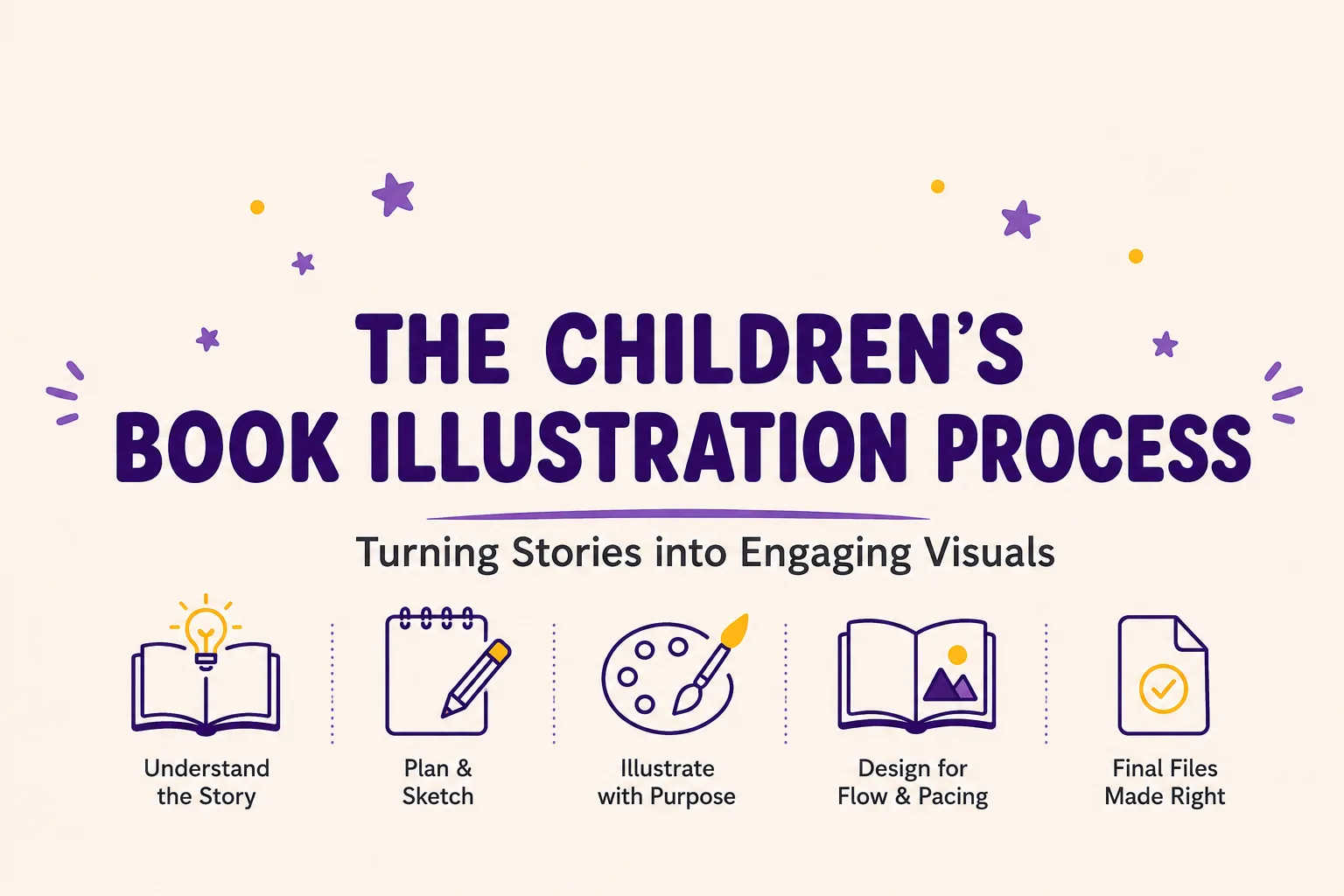
The Collaboration Workflow: From Brief to Final Files
A smooth collaboration starts with a clear brief and a structured process. When both you and the illustrator know what to expect at each stage, you'll avoid misunderstandings, cut down on revisions, and end up with a book you're genuinely proud of.
Step 1: Write a Detailed Illustrator Brief
Before contacting any illustrator, prepare a brief that communicates your vision clearly. A good brief includes a one-paragraph book summary, the target age group, trim size and page count, character descriptions with appearance, personality and clothing for each main character, scene-by-scene notes for each spread, mood and style references, text placement ideas, and technical requirements like file format, resolution and bleed.
There's a full template for this below, so you don't have to build one from scratch.
Step 2: Character Sketches
The illustrator produces rough sketches of your main characters in different expressions and poses. This is your chance to fix anything before the project moves forward. Give specific, constructive feedback: "I love the energy, but can we make her eyes a bit larger and her hair curlier?" is far more useful than "make it pop."
Step 3: Storyboard or Thumbnails
Small, rough sketches of each spread showing the flow of the book. This is where you check pacing, composition and whether the visual storytelling actually works. Pay attention to whether each spread has a clear focal point, whether there's enough variety in composition, and whether the art leaves room for the text.
Step 4: Roughs
More detailed sketches with basic shading and value. Composition and character placement should be essentially final at this point. Major changes after this stage usually cost extra, so this is the last easy opportunity to make big shifts.
Step 5: Final Art
The illustrator produces the finished, full-colour artwork. At this stage you should only be making minor tweaks, adjusting a colour, fixing a small detail. If the earlier steps were done properly, this stage tends to go smoothly.
Step 6: File Delivery
Double-check that files are 300 DPI and in CMYK colour space, that bleed is included (typically 0.125 inches beyond trim), and that text hasn't been flattened into the art unless you've agreed otherwise. This is also the point where your book formatting work begins, laying out the final art and text together for print and ebook.
Expert tip: give feedback in layers. Start with what's working, then address the biggest issues first. Avoid vague comments like "make it pop." Say something specific instead, "the character's expression feels too angry, could we try a more curious, wide-eyed look?"
Red Flags to Avoid When Hiring an Illustrator
Even with a solid process, watch for warning signs that an illustrator might not be professional, reliable, or even human.
Portfolio red flags: inconsistent quality, a few stunning pieces mixed with mediocre ones, which often suggests the best work was done under heavy art direction elsewhere. No process work at all, only polished final images with no sketches or work-in-progress shots. AI-generated signs like unnatural hands or inconsistent details between images (more on this below).
Communication red flags: vague or evasive answers about experience, process or rights. Slow response times during the hiring phase, which tend to get worse once they have your money. Any resistance to signing a written agreement.
Pricing red flags: prices under $500 for a full picture book almost always signal inexperience, AI-generated art, or a rushed, low-quality job. Requests for 100 per cent payment upfront, when reputable illustrators typically ask for a deposit of 25 to 50 per cent.
AI-specific red flags: refusal to provide work-in-progress samples, a portfolio that jumps wildly between photorealistic, cartoon and anime styles with no coherent thread, or unwillingness to include an AI-usage clause in the contract. A legitimate human illustrator has no reason to hesitate on any of these.
How to Spot AI-Generated Art: A Detection Checklist
AI-generated art has flooded online portfolios, and plenty of self-publishing authors have paid for what they thought was original work, only to find out later it wasn't. Use this checklist to protect yourself.
Visual red flags:
Hands and feet: extra fingers, fused digits, or unnatural joints. AI tools still struggle badly with hands.
Eyes and faces: asymmetrical eyes, mismatched pupils, or features that don't quite line up.
Text and symbols: gibberish lettering or distorted symbols in backgrounds.
Patterns and textures: repeated, unnatural patterns, a brick wall where the bricks don't follow perspective, or fabric that warps illogically.
Lighting inconsistencies: shadows that don't match a single light source, or highlights appearing in impossible places.
An overly smooth, "AI sheen" look, images that seem too polished, with a dreamy, plastic quality.
Portfolio and behaviour red flags:
No process work anywhere, only finished, polished images.
Wildly inconsistent styles with no coherent thread running through the work.
Refusal to provide work-in-progress samples on request.
Unwillingness to include an AI-usage clause in the contract.
No online presence beyond a single portfolio page, no social media, no website, nothing showing personality or process.
Inability to create a consistent character on demand. Ask for a quick sketch of your main character in a specific pose. A genuine illustrator can do this; someone relying on AI generation will struggle to replicate a specific, consistent character across multiple images.
Expert tip: if you're still unsure, ask for a live screen-share where the illustrator shows their working file with layers visible. A human illustrator's file will have sketch layers, adjustment layers and a clear, non-destructive workflow. An AI-generated image is typically a single flat layer with nothing underneath it.
Illustrator Brief Template
Use this template to build a clear, comprehensive brief before you contact any illustrators. It bridges the communication gap and cuts down on revision rounds later.
Book information
Working title
Author name
Target age group (for example, 3 to 6 years)
Genre or tone (for example, humorous, heartfelt, adventurous)
Trim size (for example, 8.5" x 8.5")
Page count (for example, 32 pages)
Illustration count (for example, 14 full spreads plus cover)
Story summary
A one-paragraph synopsis covering the main characters, the central conflict, and the emotional arc.
Character descriptions
For each main character: name, age, physical appearance (hair, eyes, build, distinguishing features), clothing and style, personality traits, key expressions or poses needed, and reference images if you have them.
Scene-by-scene breakdown
For each spread: the page or spread number, the exact text appearing on it, a visual description of what's happening and the mood, a text placement idea, and any elements that absolutely must be included.
Mood and style references
Links to three to five books or illustrations that capture the feel you're after, noting specifically what you like about each, colour palette, character design, use of light, composition.
Technical specifications
File format (layered PSD or AI, 300 DPI, CMYK), bleed requirements (typically 0.125" on all sides), and any printer-specific requirements.
Fill this out properly before you reach out to anyone. It turns a vague "I want something whimsical" conversation into a brief an illustrator can actually work from, and it's the single biggest thing you can do to reduce revision rounds later.
Final Hiring Checklist
Define your book's needs: age group, trim size, page count, illustration count, style direction.
Prepare a detailed illustrator brief using the template above.
Search across multiple platforms: Illustrators Australia, Reedsy, Behance, Instagram, and consider a publishing partner if you'd rather not manage it solo.
Shortlist three to five illustrators whose style matches your book.
Evaluate portfolios using the technical checklist: character consistency, composition, gutter and bleed, lighting, texture, white space, storytelling.
Check for AI red flags using the detection checklist.
Contact your shortlist with your brief and ask the essential questions.
Request a paid sample or character sketch from your top candidates.
Check references and testimonials, and look at final printed books they've illustrated where possible.
Negotiate and agree on price, timeline and revision policy.
Review the contract carefully: scope, payment, revisions, rights, kill fee, AI usage, confidentiality.
Sign the contract and pay the deposit. Never the full amount upfront.
Kick off the collaboration with a call to align on vision and process before any art begins.
What Comes Next
Choosing an illustrator is one part of a much bigger self-publishing journey. Once the artwork is locked in, most authors move on to layout, cover design, printing and getting the book in front of readers.
If you haven't started writing yet, or you're stuck partway through, our ghostwriting and fiction ghostwriting services can help turn your idea into a finished manuscript ready for illustration. Once the manuscript and art are both ready, a proofreading pass catches anything that slipped through earlier drafts before the book goes to print.
After illustration, most authors want somewhere to showcase the finished book. An author website gives readers, schools and bookshops a place to find you, and a short children's book trailer built from your illustrations can be a genuinely effective way to promote a picture book online. Some authors also turn the finished manuscript into an audiobook once the illustrated edition is out, giving the story a second life for families who listen on the go.
From there, it's distribution, getting the finished, illustrated book into shops, libraries and online stores. If you'd rather work with a publisher than manage the whole self-publishing pipeline yourself, our guide on how to find a children's book publisher walks through that alternative path.
At Purple Giraffe Press, we help authors through every one of these stages, including matching manuscripts with illustrators who understand exactly what a printed children's book needs. If you'd rather not manage illustrators, printers and formatting separately, our book publishing service brings it all together under one roof.
This guide was built to give you the confidence and tools to hire an illustrator who becomes a genuine creative partner, not just a supplier. The right illustrator doesn't just draw your story. They add depth, emotion and a visual language that makes children want to read it again and again. Take your time, use the checklists, and trust the process. Your book deserves it.
Ready when you are
Let's bring your children's book to life.
From a first idea to a finished book children adore, we are with you at every step. Tell us about your story and we'll reply within one business day.
Start Publishing →