If you've typed some version of "how much does it cost to publish a children's book in Ireland" into a search bar, you've probably come away more confused than when you started. Every guide seems to quote a different figure, and most of them don't agree with each other. That's not because anyone is being dishonest with you. It's because a children's book quote can bundle wildly different things depending on who's giving it, and most of what you'll find online is written for authors in the United States, priced in dollars, under rules that simply don't apply in Ireland.
This guide takes a different approach. Instead of handing you a borrowed number that may have nothing to do with your book, it walks through every real factor that shapes what a children's book costs to produce here, including the Irish-specific details that general publishing advice skips entirely. That means the production stages themselves, what pushes a price up or down, how the process differs depending on your book's age group and format, and the tax, legal, and funding questions that only apply once you're publishing inside Ireland.
By the end, you'll understand exactly what you're budgeting for and why, which is a far more useful place to start than a figure that was never written with your book in mind. You'll also know what to ask any illustrator, editor or publishing partner before you agree to anything, which matters just as much as understanding the costs themselves.
What Actually Goes Into the Cost of Publishing a Children's Book in Ireland?
Picture Aoife, a first-time author in Dublin who has just finished the text for a picture book about her grandmother's garden. She requests three quotes and gets back three completely different numbers, with almost no explanation of what each one actually includes. This happens constantly, and it's rarely anyone's fault. Publishing a children's book involves several distinct stages, and every provider bundles them differently.
In plain terms, those stages are editing and proofreading, illustration, design and layout, ISBN registration, printing, and launch and promotion. A quote that only covers editing and formatting will look nothing like one that also includes a full set of commissioned illustrations, even though both might be described as "publishing a children's book." Before you can make sense of any number, you need to know which of these stages it's actually paying for.
Two providers can look at the exact same finished manuscript and come back with answers that seem almost impossible to reconcile, simply because one assumed you already had an illustrator lined up, and the other assumed you didn't. Neither is being unreasonable. They're just answering a different question than the one you thought you were asking, which is exactly why this guide works through each stage on its own rather than trying to collapse everything into one tidy figure.
It also helps to be clear on what kind of children's book you're making, since that shapes every decision from here. A picture book, a work of fiction, and a nonfiction title for young readers each come with different production needs. If you're not sure where your manuscript sits, it's worth reading up on the difference between fiction and nonfiction and the broader landscape of children's book genres before you request a single quote.
One thing is true for almost every children's book, and it's the single biggest reason cost guides written for general self-publishing don't apply here: illustration changes everything. That's worth its own section, because it's the part most authors underestimate.
If what you actually need is full support through this process rather than a DIY approach, children's book publishing support exists precisely for authors in Aoife's position, people with a finished manuscript and no clear map of what comes next.
There's a genuine upside to understanding the stages properly, even if you end up handing most of them to someone else: it means you can read a quote and know exactly what you're looking at, rather than taking a bundled number on faith and hoping it covers what you actually need.
Why Does a Children's Book Cost More Than a Novel?
A children's book, especially a picture book, usually costs more to produce than a same-length novel, and the reason is straightforward: illustration is a major, unavoidable line item that a text-only book simply doesn't have. A novelist needs a cover. A picture book author needs a cover and a full set of interior illustrations that carry as much of the story as the words do, sometimes more.
Picture books are also physically different products. They're printed in full colour throughout, designed around specific trim sizes and bleed, and laid out as spreads rather than straight pages of text. None of that is interchangeable with standard paperback formatting, which is one reason a quote built for a novel manuscript will never map cleanly onto a picture book.
Think about what actually happens on a typical picture book spread: text has to share the page with art in a way that doesn't crowd either one, colours need to stay consistent from the first page to the last, and a page turn often has to land on a small moment of surprise or anticipation for a young reader. None of that happens by accident, and none of it exists in a standard novel layout, which is why the production process genuinely diverges from the moment illustration enters the picture.
There's a quality dimension here too, not just a cost one. A strong story paired with rushed or flat illustration genuinely underperforms once it's on a shelf or in front of a parent scrolling through options online. Cutting corners on artwork has a real cost of its own, even when it isn't a cash cost, because it's the illustration that usually sells the book in the first three seconds, long before anyone reads a single line of the story itself.
None of this means publishing a children's book has to be out of reach. It means the money is going somewhere different from what readers coming from general self-publishing advice tend to expect, and once you understand where, the rest of the decisions get a lot easier to make.
It's also worth saying plainly: a picture book isn't simply a longer, more expensive version of a novel. It's a different kind of object entirely, built around the relationship between words and pictures on a page, and the production process reflects that from the very first spread to the last.
What Actually Moves the Price Up or Down?
The cost of publishing a children's book swings on a handful of real, identifiable factors, and understanding them is far more useful than hunting for a single average figure that was never going to match your project anyway.
Publishing route matters first. Self-publishing puts every decision, and every cost, directly in your hands. Hybrid publishing shares some of that cost and risk with a publishing partner, in exchange for giving up a degree of control. We'll cover the practical difference properly in a later section, because it's one of the first decisions worth making.
Age category and format matter just as much. A picture book, an early reader, and a middle grade novel have completely different illustration needs, different page counts, and different design conventions, which we'll walk through below.
Colour versus black and white is another lever. Full colour illustration throughout a book costs more to produce and print than spot illustration or a black and white interior, simply because every spread needs original artwork rather than occasional accents.
Print method and run size change the economics independently of everything else. How a book is printed, and how many copies are produced in one go, affects per-copy cost in ways that have nothing to do with the creative work itself.
Then there's a genuinely Irish consideration: whether you're publishing in English, in Irish, or producing a dual-language edition. Publishing in Irish opens different funding routes, which we'll come back to, but it also adds translation or dual-language production work that needs to be planned for properly from the outset, rather than tacked on once the English edition is already finished.
Page count plays its own quiet role too. A thirty-two-page picture book and a twenty-four-page one aren't a small difference once you account for the extra spreads of original artwork that each additional page actually needs, even though the word count barely changes between them. The same logic applies in the other direction for a middle grade novel, where page count affects editing and printing far more than it affects illustration.
Finally, how much groundwork you're starting with matters enormously. An author who already has an illustrator lined up, a polished manuscript, and a clear sense of their audience needs far less professional support than someone starting completely from scratch. Aoife, for instance, had a finished manuscript but no illustrator and no idea where to find one, which shaped almost every quote she received. Someone in the opposite position, with illustration sorted but a manuscript that still needs structural work, would see a completely different set of numbers for the same stages, which is exactly the point: there's no single children's book to price, only your specific one.
What Does Each Stage of Publishing a Children's Book Actually Involve?
Each stage of publishing a children's book involves real, specific work, and what you actually need from each one depends on your book's format, your chosen route, and how much you're planning to handle yourself. Walking through them properly, rather than treating "publishing" as one single purchase, is the single most useful thing you can do before requesting a quote from anyone.
Editing and Proofreading for Children's Books
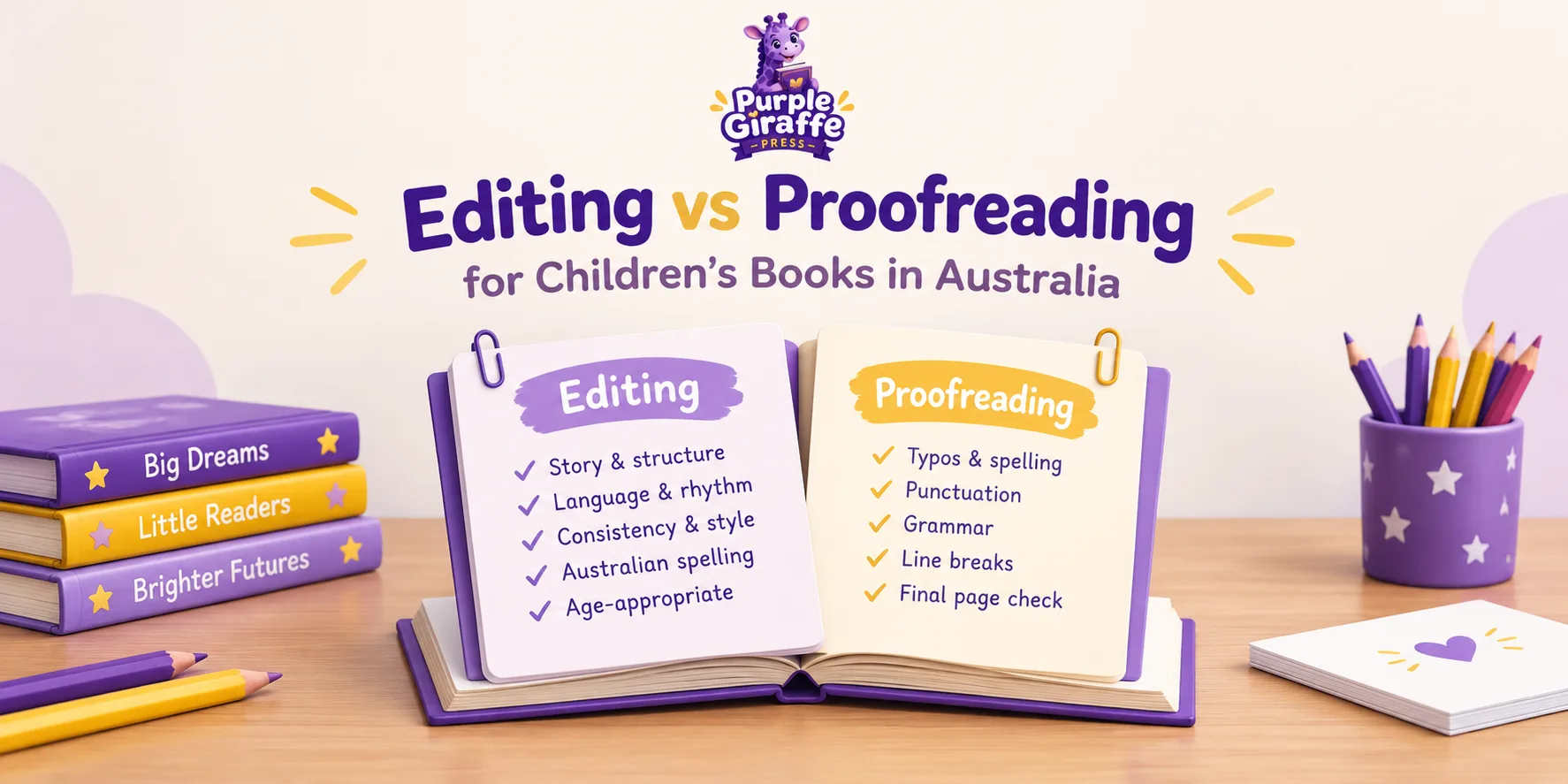
A structural or developmental edit looks at the bones of your story: pacing, whether the plot holds together across a short page count, whether the voice actually sounds like a child's world rather than an adult's idea of one. For a picture book specifically, a good developmental pass also looks at rhythm, since these are often books meant to be read aloud, and at how each page turn lands, since that small moment of anticipation is part of what makes a picture book work. A proofread comes much later, after design, and catches the small errors that slip through everything else: a dropped word, a typo, an inconsistent character name, a line that reads fine silently but trips over itself out loud.
Even a short picture book manuscript benefits from both passes, and they're not interchangeable. It's also worth knowing the practical difference between the two before you request a quote, since editing versus proofreading for children's books is a distinction that genuinely affects what you're paying for and when in the process it happens. If you want a professional pass on your manuscript before illustration begins, editing services are exactly where that conversation starts.
Small craft details matter here too. Authors regularly trip over word choices they assumed were settled, like whether a habit is ingrained or engrained, and a good editor catches these before they reach print, not after.
Illustration: Your Book's Biggest Cost Driver
This is where most of a picture book's budget actually goes, and for good reason. Commissioning illustration properly involves style discovery (finding an artist whose approach genuinely suits your story), character development so your protagonist looks consistent across every spread, and a clear understanding of spot illustrations versus full spread artwork, since these require very different amounts of work. A palette gets settled early too, since colour has to hold together across every page rather than shifting from spread to spread, and a professional process builds in a set number of revision rounds, because the first draft of any illustration is rarely the final one.
Think back to Aoife's grandmother's garden story: the illustrator doesn't just need to draw a garden once. They need to draw the same garden, the same grandmother, the same visual world, consistently across every page, in a style that matches the warmth of the text, which is a very different task from a single standalone piece of artwork. Custom illustration built around this kind of continuity is what actually makes a picture book feel like one coherent world rather than a collection of separate pictures.
Illustration in a children's book does more than decorate the page. It carries tone, pacing, and sometimes plot information the text never states outright, which is worth understanding properly if you want your book to work the way the best ones do. There's more on what imagery actually does in a children's book, and a deeper look at children's book illustration for anyone who wants to go further before commissioning anything.
One more thing worth flagging early: who owns the final artwork once it's finished is a decision made at this stage, not an afterthought you sort out later. We'll come back to this properly when we talk about judging a quote, but it's worth having in mind from the very first conversation with an illustrator, not the last.
Design, Layout and Formatting for Picture Books vs Chapter Books
Formatting a full colour picture book, with its trim size, bleed, and spread-by-spread layout, is a genuinely different skill from formatting a text-heavy chapter book. A picture book formatter is essentially solving a design problem on every single page: where text sits against the art, how much white space a page needs to breathe, how a reader's eye moves across a spread before the page turn. A chapter book formatter is solving a completely different problem, mostly around consistent typography and readable pacing across far more pages of text. Treating them as the same job is one of the more common mistakes first-time authors make when comparing quotes. Book formatting services built specifically around children's books account for this difference from the start.
Cover design deserves its own mention, separate from interior illustration. A cover has to work as a tiny thumbnail on a retailer's page just as well as it works as a printed object in someone's hands, which is a genuinely different design problem to solve: what reads clearly at full size can disappear completely at thumbnail scale, and a cover that was never tested that way often doesn't survive contact with an online shop. Book cover design that understands both contexts is worth treating as its own line item rather than an extension of interior artwork.
ISBN and Registering Your Book
Here's a detail that trips up a lot of first-time Irish authors: there isn't a separate Irish ISBN body. Books published in Ireland are registered through the same agency that covers the United Kingdom, which feels counterintuitive until you know it, and then it's simply a practical step rather than a mystery. Each format and edition of your book- a print version, an ebook, an Irish language edition- typically needs its own ISBN, so this is worth planning for rather than discovering halfway through.
It's also worth applying early rather than at the last minute. An ISBN needs to be in place before final files go to print, since it's usually printed directly onto the back cover as a barcode, and leaving this until the week of printing is a common and entirely avoidable source of delay.
Printing Your Children's Book
The real choice here is between print on demand, where each copy is produced as it's ordered, and a bulk print run produced in one batch ahead of time. Print on demand keeps upfront risk low and avoids a garage full of unsold stock, while a bulk run can improve the economics once you're confident in demand, at the cost of committing to a quantity upfront. Picture books complicate this further, because full colour printing, and often heavier board stock for younger readers, behaves differently to standard paperback printing in terms of both process and the kind of printer you need.
Print quality matters more for a children's book than for most formats. A parent flipping through a copy in a shop, or a librarian deciding what to stock, is judging colour accuracy and durability just as much as the story itself. Children's book printing handled by people who understand picture book production specifically avoids a lot of the quality problems that show up when a general printer takes on a job they haven't done before.
Launch, Promotion and Distribution in Ireland
A children's book launch in Ireland tends to look different to the generic "author event" most self-publishing advice describes. Think local bookshops, libraries, school visits, and family-friendly launch events rather than a quiet evening reading to other adults. A good launch often starts building momentum weeks beforehand too, through local school or library contacts, rather than appearing out of nowhere on publication day. Getting your book in front of the right local audience is its own skill, and book promotion built around children's books understands which of these routes actually work for this specific audience.
Distribution is a separate step from simply having your book printed and available to order online. Getting a children's book into Irish bookshops and libraries takes its own groundwork: knowing who to contact, how stock is typically supplied, and how long that process realistically takes. It's worth planning for as a distinct stage rather than assuming it happens automatically once the book exists.
Self-Publishing or Hybrid Publishing: Which Route Fits Your Children's Book?
The two realistic routes for most Irish authors today are self-publishing and hybrid publishing, and the right one depends on how much control you want to keep versus how much support you'd rather have built in from the start.
Self-publishing puts everything in your hands: every decision, every stage, every cost, and in return, full ownership and full creative control. It suits authors who either have the time and inclination to manage each stage themselves, or who want to bring in specific professional help (an illustrator here, a formatter there) while still directing the overall project personally. It also means you're the one chasing deadlines, coordinating between an illustrator and a formatter, and making the final call on every creative decision, which some authors genuinely enjoy and others find exhausting on top of everything else life involves.
Hybrid publishing sits differently. It's a genuine middle path worth understanding properly rather than dismissing as a compromise, since the specifics of what's shared between author and publisher vary enormously depending on the arrangement. For an author who wants the process managed end to end, rather than personally coordinating each individual stage, this route trades some of that hands-on control for a team already set up to handle it. If you want the real breakdown of what this actually involves for a children's book specifically, hybrid publishing for children's books and what it really costs covers it properly.
Neither route is automatically the right answer. The honest question to ask yourself is how much of this process you actually want to run personally, versus how much you'd rather hand to people who do this full time, and how much that trade-off is worth to you compared with doing it all yourself.
A useful way to test this before deciding is to picture yourself three months into the project. If the thought of juggling an illustrator's schedule, a formatter's feedback and a printer's proof approval alongside everything else in your life sounds manageable, self-publishing probably suits you. If it sounds like exactly the kind of coordination you'd rather hand to someone else, that's a genuine signal worth listening to, not a failure of ambition.
It's also worth knowing that neither route requires you to write the manuscript entirely alone. Some authors have a story they want told but struggle to get it onto the page in a way that works for the intended age group, and ghostwriting services exist for exactly that situation. Others have a strong idea for a fiction title and want help shaping it before illustration even begins, which is where fiction ghostwriting comes in. Needing help with the writing itself doesn't mean giving up on the book being genuinely yours.
Does the Age Group or Format Change What You'll Pay?
Yes, and this is one of the clearest cost drivers in the entire process. A picture book, an early reader, and a middle grade novel are fundamentally different products to produce, and assuming one children's book costs the same as another is one of the fastest ways to end up with a quote that doesn't make sense.
Picture books, roughly aimed at readers up to around six years old, carry full colour illustration throughout, a low word count, and the highest illustration-to-text ratio of any children's format. This is why they typically represent the most illustration-intensive, and therefore most design-heavy, end of the spectrum. Understanding picture book format properly before you start- trim size, spread count, how text and art share the page- saves a huge amount of back and forth later.
Early readers and chapter books sit in the middle. They mix text and illustration, but artwork plays a supporting role rather than carrying equal weight with the words, which shifts production effort away from illustration and toward layout and pacing. Vocabulary and sentence length also need to match the reading stage precisely, which is as much an editorial consideration as a creative one.
Middle grade novels are mostly text, with illustration usually limited to a cover and the occasional interior spot image. This shifts the cost balance firmly toward editing and story development rather than artwork, which is worth knowing if you're comparing a middle grade quote against a picture book one and wondering why they look so different.
How you build character matters here too, and it works differently depending on format. A protagonist in a children's book develops differently to a main character in adult fiction, and getting this right at the manuscript stage affects both the editorial work and the illustration brief that follows it.
What Should Irish Authors Know About Tax, VAT and Legal Requirements?
This is the part almost no general publishing guide gets right, because it's specific to Ireland, and it genuinely changes how you should think about your budget and your timeline.
VAT on Children's Book Publishing Services
Printed books themselves and the professional services that go into making one- editing, illustration, design- aren't automatically treated the same way under Irish VAT rules. This catches people out constantly: a quote that looks reasonable can land differently once VAT is factored in, or not factored in, depending on how it was presented. Two quotes that look nearly identical on paper can end up meaningfully different once this is accounted for, which is exactly why it deserves a direct question rather than an assumption. Always ask directly whether a figure you've been given is VAT inclusive before you commit to anything, and treat this as a standard question rather than an awkward one.
The Artists' Exemption, Explained Properly
Many Irish authors have heard of the Artists' Exemption and assume, understandably but wrongly, that it somehow reduces what they pay to publish. It doesn't. The exemption relates to income tax on qualifying creative income once your book is earning money, not to the cost of producing it. It also doesn't cover other charges like USC or PRSI, and it only applies to work that meets specific creative and artistic merit criteria rather than covering every kind of writing automatically. These are two entirely separate conversations, one about what you earn and one about what you spend, and conflating them leads to budgeting mistakes that are easy to avoid once you know the difference.
The Legal Deposit Rule Almost No One Tells You About
Here's a genuinely practical fact that's missing from nearly every publishing guide written for Irish authors: if you self-publish a book in Ireland, you have a legal obligation under Irish copyright law to send a copy to a specified list of libraries within a set period after publication, with a further set of libraries entitled to request a copy afterward. This applies to self-published authors just as much as it applies to established publishers, which surprises a lot of people who assume legal deposit is something only large publishing houses need to think about. This isn't a scare point; it's simply a step in the process, and it's a straightforward one once you know it exists. Most first-time authors don't, and find out the hard way, usually when a library gets in touch after the fact.
There's also a quieter, genuinely useful fact worth knowing here: competitive creative sector support exists specifically for children's book writers and illustrators in Ireland, aimed at giving creators time and resources to do the work itself rather than directly funding production costs. It's worth researching properly before assuming every cent of your project has to come from your own pocket, even though it won't replace the need for a clear production budget.
How Do You Know If a Children's Book Publishing Quote Is Fair?
A children's book publishing quote is worth questioning carefully if it leaves out any of a few specific things, and knowing what to ask for puts you back in control of a conversation that can otherwise feel one-sided.
Start with illustration rights. A fair quote states plainly whether you own the final artwork outright once it's paid for. This matters specifically because it's illustrated work, and it simply doesn't come up with a plain text manuscript, so don't assume it's covered unless you've asked directly.
Ask for an itemised breakdown rather than accepting one bundled figure. Editing, illustration, design, formatting, printing, and ISBN registration are all distinct pieces of work, and you should be able to see what you're paying for each one. If a provider can't or won't break this down, treat that as a signal worth paying attention to.
A legitimate illustrator or publishing partner should be willing to show sample pages or a sample spread before you commit to the full project. If you're being asked to sign off on an entire book sight unseen, that's worth pushing back on.
Be wary of a timeline that doesn't allow for genuine illustration and revision time. Good artwork takes real hours, and a quote promising a fully illustrated children's book far faster than that process realistically allows is a quote worth questioning.
Pay attention to how payment is structured too. A fair arrangement typically ties payment to clear milestones: a manuscript edit signed off, a set of roughs approved, final files delivered, rather than asking for the full amount upfront before any work has actually started. If you can't get a straight answer about what happens if you're not happy with a milestone along the way, treat that as part of the answer.
Finally, confirm plainly whether proofreading is included or priced separately. It's one of the easiest line items to assume is bundled in when it genuinely isn't, and a final, professional proofreading pass is not the place to discover a gap in what you've paid for.
How Does Publishing in Ireland Compare to the US or UK?
If you've spent any time researching this topic, you've almost certainly run into content written for an American audience. That's exactly why a guide specific to Ireland matters: the underlying stages of producing a children's book are the same everywhere, but the tax treatment, the ISBN process, the legal requirements, and the funding landscape covered above are specific to Ireland and simply don't transfer from US or UK advice.
If you want the equivalent picture for the American market, for comparison or because you're weighing up publishing in both regions, how much it costs to publish a children's book in the USA covers that ground properly. The two aren't interchangeable though, and the handful of things that are genuinely different here- VAT treatment, the Artists' Exemption, the shared UK and Ireland ISBN process, and the legal deposit requirement- are exactly why borrowing a number from elsewhere rarely gives you an honest picture.
This matters even if you only ever plan to sell within Ireland. A quote, a piece of advice, or a cost figure that looks authoritative because it came from a well-ranked article isn't automatically relevant to you if it was written for a different country's tax system and a different currency entirely.
Ready to Find Out What Your Children's Book Will Actually Cost?
The only way to get an honest number is a direct conversation about your specific book: its format, its illustration needs, and the route that actually fits what you're trying to achieve. That's precisely what a tailored conversation with Purple Giraffe Press is for, rather than another borrowed figure from a guide that was never written with your manuscript in mind. Bring whatever you have, a finished manuscript, a half-finished draft, or just an idea you haven't put on paper yet, and the conversation starts from exactly where you are.
Once your book itself is underway, it's worth thinking a step further too. Many authors build an author website alongside their launch, giving readers a permanent home to find them beyond a single release, and some choose to extend their story into an audiobook once the print edition is settled, reaching readers who prefer to listen rather than read on the page.
If Aoife's situation sounds familiar- a finished manuscript, no illustrator, and a pile of quotes that don't quite make sense- that's exactly the starting point Purple Giraffe Press works from every day. Get in touch for a tailored conversation about your own children's book, and get a clear, honest picture of what it actually needs, stage by stage, rather than a number borrowed from somewhere else and hoped to be close enough.
Ready when you are
Let's bring your children's book to life.
From a first idea to a finished book children adore, we are with you at every step. Tell us about your story and we'll reply within one business day.
Start Publishing →