You searched for the cost to publish a children's book in the USA, and you probably found five answers that disagree with each other. Nobody is lying to you. A children's book simply isn't one purchase. It's a handful of separate jobs: illustration, editing, layout, cover design, an identifier for each format, printing, and a plan to reach readers. Every author needs a different mix of them.
So here's the short, honest answer to how much it costs to publish a children's book in the USA: it depends on the route you choose, the length and look of the book, who creates the art, and how much help you want. Illustration is usually the largest line. Printing may not be an upfront expense at all. And some routes ask you to pay nothing to be published, with trade-offs of their own.
This guide won't hand you a number to copy, because a borrowed number is the fastest way to plan the wrong budget. It shows what each line buys, what moves it, and how to build your own total from real quotes. You'll also get a fill-in worksheet, a red-flag table for judging quotes, and a simple method for checking whether your spend is working.
Does It Cost Money to Publish a Children's Book in the USA?
It depends on the route. A traditional publisher funds production, so the author isn't charged to be published. Self-publishing means you pay providers for each step. Hybrid publishers charge the author upfront fees. A company that charges only for the right to use its name is a vanity press.
The simplest rule in publishing is that money should flow toward the author. A traditional publisher pays for editing, art, design, printing and distribution, keeps most of the revenue, and absorbs the loss if the book doesn't sell. That's why its editors are selective. If a company asks you to pay while acting like a gatekeeper, something is off.
A word on "free." Some routes advertise publishing at no charge. That can be true in a narrow sense: a platform may let you upload files without paying to list the book. But the files still have to come from somewhere, and the book still needs art, editing and a cover to compete. "Free to list" and "free to produce" are different things, and mixing them up is how first-time authors end up with a book that looks unfinished.
None of this makes every paid service a bad idea. When you self-publish, you become the publisher, and a publisher pays for production. The real question isn't whether money leaves your account. It's whether what you're buying is worth it, whether you keep control and your rights, and whether you can see exactly what you're getting.
Path | Who pays for production | Who typically owns the rights | Who controls creative decisions | Best fit |
Traditional | The publisher | Negotiated in the contract, often licensed to the publisher | Mostly the publisher | Authors who want the publisher to carry the risk and can wait through submissions |
Self-publishing | The author, paid to providers | The author | The author | Authors who want control, speed, and ownership and will manage vendors |
Hybrid | The author pays upfront fees, and the publisher shares in the work | Varies, so read the contract carefully | Shared, and it varies | Authors who want a team and have vetted the publisher thoroughly |
Vanity (avoid) | The author, mainly for the imprint or a print run | Often unclear or restrictive | Limited | Rarely a good fit |
Traditional publishing
Most picture book manuscripts reach established houses through literary agents or open submission windows. The publisher usually chooses the illustrator, which surprises authors who already have a particular artist in mind. Competition is stiff, and timelines are long, often measured in years. If an agent represents you, the agent is typically paid from your earnings rather than upfront, but read any agency agreement closely before you sign. Prepare a clean manuscript and a short query letter, and don't attach finished art unless you're a professional illustrator submitting as an author-illustrator, since houses often prefer to pair text with their own artists.
Self-publishing
You commission or handle every step, keep your rights, set your own schedule, and carry the risk. Some authors assemble freelancers one at a time. Others work with a team that manages the project from first edit to final files, such as children's book publishing services that cover the whole path. Either way, you stay the owner of the book.
Hybrid publishing
Hybrid publishing combines author funding with publishing support. The author pays for agreed services, while the publisher manages work such as editing, illustration, design and production. Distribution and marketing may also be included, but the scope varies between providers.
The agreement should explain what the upfront fees cover, how earnings are calculated and which decisions remain with the author. If payments are based on “net receipts,” the contract should define the deductions made before the author’s share is calculated. Rights, revision rounds, delivery dates, and arrangements for ending the agreement should also be clear.
Our guide to hybrid publishing for children's books explains the model in more detail. When planning your budget, use the specific services and terms in the proposal to establish what you are paying for.
Vanity publishing
A vanity press earns its money from authors, not readers. The usual signs: it accepts nearly everything, charges mainly for its imprint or a print run, and does little real editing, distribution, or marketing. Paying only for the right to use someone's name is the core of vanity publishing. We'll come back to spotting one in the red-flags section.
If you're self-publishing or working with a service team, the next section shows what the money actually buys.
What Do You Pay for When You Publish a Children's Book?
Most budgets break into eight lines: illustration, editing, interior layout, cover design, ISBN and barcode, printing and distribution, ebook and audio, and marketing. Illustration is typically the largest because a picture book needs art on every spread, while print-on-demand printing is often deducted from sales rather than paid upfront.
That's the order of impact, not the order of work. Editing comes before layout, and the cover is usually finished last. As you read each line, jot down what you need and collect quotes. The worksheet at the end of this section gives you a place to put them.
Illustration
Illustration is usually the largest line because a picture book needs original art across the whole book, often as double-page spreads. What you pay for depends on the artist's experience, how detailed and consistent the style is, how many spreads there are, and the rights you need.
A professional job covers character design, sketches, color roughs, final art, revision rounds and usage rights. Quotes move with the number of spreads, how complex the style is (simple shapes versus layered, painterly scenes), how many recurring characters appear, how many rounds of changes you want, your deadline, and the file formats you need.
You have three realistic options. You can hire an independent illustrator, work with a team that handles art as part of the project, such as custom illustrations, or create the art yourself if you're an author-illustrator. Be honest with yourself about quality. Art shows on every page, and parents choosing a book at a shelf or on a screen judge it in seconds. Our overview of children's book illustration explains the common styles so you can describe what you want.
A clear brief saves rounds of changes. Before you contact anyone, write down:
The age range and the feeling of the book, such as a calm bedtime story, a silly rhyme or curious nonfiction.
The page count and trim size, so the artist knows how many spreads to plan.
A description of each main character, including anything that must stay consistent, like a scar, a favorite hat or a dog's markings.
Two or three reference images for mood and color, used for inspiration rather than copying.
Your deadline and how many rounds of feedback you expect.
Ask for a short character sample before agreeing to the full project. A sample shows whether the artist understands your story, and you'll learn a lot from how they respond to your feedback.
Your manuscript affects this line too. A good text leaves room for the pictures. If the words describe what the illustration already shows, you're paying twice for the same idea. That's where imagery in a children's book earns its keep: vivid word pictures let the artist add something new instead of repeating the text.
Ask who owns the finished art and what you can use it for, whether that's the book, merchandise or ads. The rights section below covers this, including a note on AI-generated art.
Editing and proofreading
Picture book text is short, but it still needs professional editing and a final proofread, because every word is visible and read aloud. Editors charge by project or by word depending on the service, and developmental, copy, and proofreading passes are separate jobs.
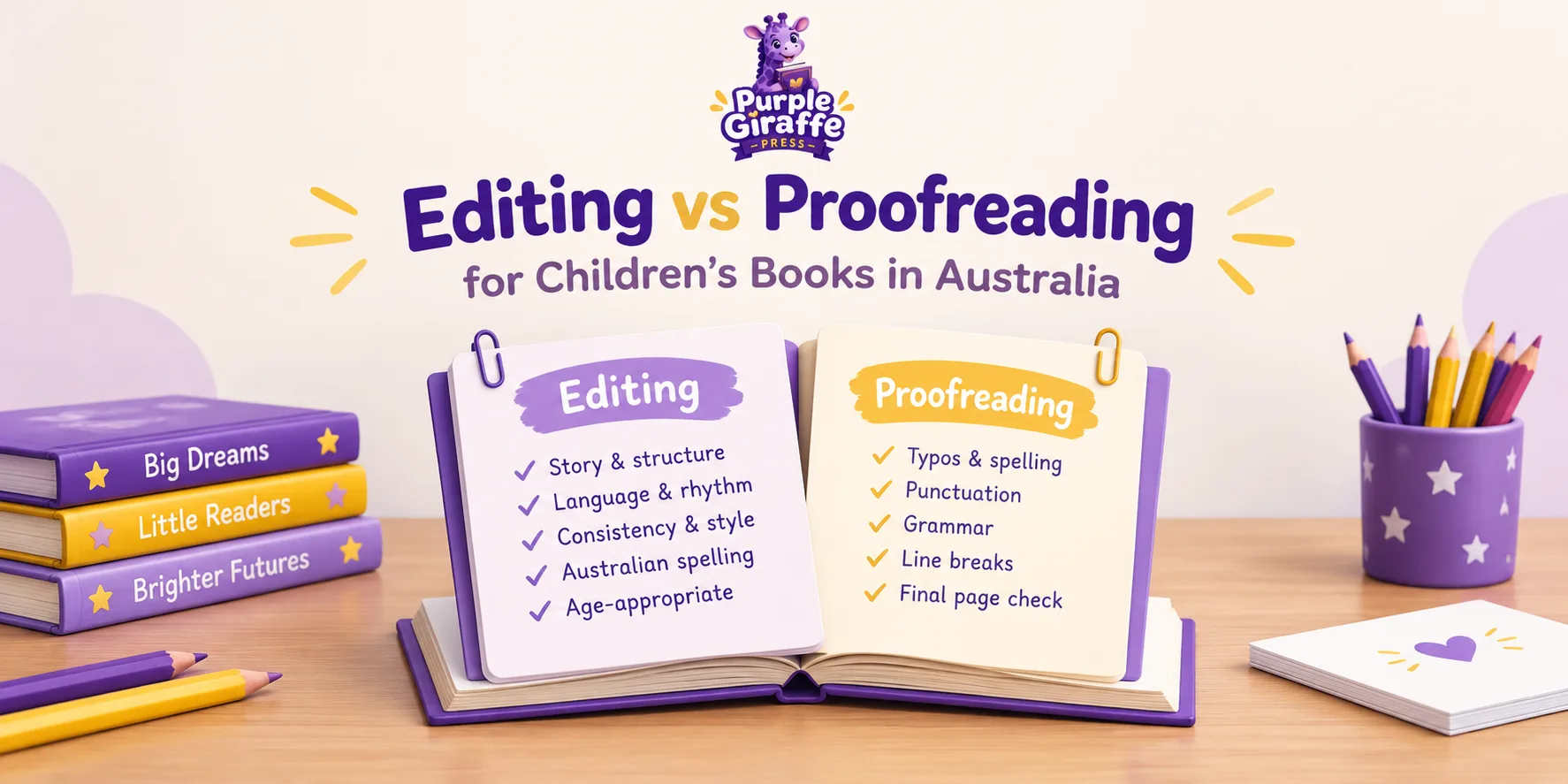
A developmental or story edit looks at structure, voice, and read-aloud rhythm. A copyedit fixes grammar and consistency. A proofread is the last check, done after layout, because layout can introduce new errors. Quotes depend on manuscript length, how polished the draft is, and how many passes you need. If you're unsure which pass fits your draft, our guide to editing vs proofreading for children's books breaks down the difference, and our editing services cover the story-level work.
Try this before you hire anyone: read the manuscript aloud to a child, or to an adult pretending to be one, and mark every spot where you stumble, where attention drifts, or where the words repeat what a picture would show. Those marks become your editor's starting point, and a cleaner draft makes for a more focused edit.
A story edit often catches things authors can't see. Say your hero is a shy otter, but the story is really driven by her cousin, who makes every decision. Young listeners will follow the character who acts, so an editor may suggest shifting the focus. If you want to understand that distinction yourself, read about protagonist vs main character before you send the draft out.
Save the proofreading pass for the very end. It's where a trained eye catches the small slips that survive every earlier read, including commonly confused pairs such as ingrained vs engrained.
Interior layout and formatting
Layout turns the manuscript and art into print-ready pages. In a picture book, it controls text placement, page count, bleeds, and trim size, so it's more design work than formatting a novel. You can hire a designer or use a template if you have the skills.
A layout job includes page setup, text placed against the art, fonts that suit early readers, front matter, a print-ready PDF, and an ebook file. Quotes change with page count, trim size, the number of spreads, how tightly the text interacts with the art, and how many formats you need. Page counts are tied to how books are printed, and multiples of 8 pages are common, with 32 pages a familiar default. That makes page planning a design decision and a budget decision at the same time.
Keep important text away from the center fold and the trim edges. A line that looks perfect on screen can disappear into the gutter once the pages are bound, which is one more reason to check a printed proof.
Professional book formatting keeps the files consistent and printer-ready. If you're still deciding on dimensions and page structure, our explainer on picture book format is a good place to start.
Cover design
The cover is the first thing readers see, and a children's book cover has to work as a small thumbnail online and as a full wrap in print. Cover work usually includes the front, spine, and back, and the quote depends on whether the illustrator or a separate designer handles it.
The wrap dimensions depend on page count, trim size, and paper, so the cover is finalized after the interior. Quotes change with the number of concepts, the revision rounds, whether you're making a hardcover or paperback, and whether the art is new or reused from inside the book. A dedicated book cover design service handles those technical details alongside the creative ones.
ISBN and barcode
An ISBN identifies a particular edition and format of a book. It helps retailers, distributors, and libraries distinguish a paperback from a hardcover or another edition. ISBN requirements depend on the format and the sales channels you intend to use.
Some publishing arrangements include an ISBN, while others leave it to the author to obtain one. An included or free ISBN may come with restrictions concerning the publisher name shown in the record or where that edition can be distributed. These details should be clear before the book is registered.
An ISBN registered under your own publishing name gives you control over the associated publisher information. However, the book details still need to match across the ISBN record, production files, and distribution listings. Paperback and hardcover editions use separate ISBNs, while ebook requirements vary by sales channel.
A barcode represents the ISBN in a scannable form for printed books. A quote should state whether ISBN registration and barcode preparation are included, who manages the records, and which formats are covered. These details help you plan distribution and avoid paying twice for the same task.
Printing and distribution
Printing comes in two models. Print-on-demand makes each copy when it's ordered, so there's no inventory and the printing charge is typically deducted from sales. Offset printing produces a run in advance, which is paid upfront but suits events, schools, and bookstore sales. Full-color picture books affect both.
Think of it as cash flow. With print-on-demand, you spend little before launch, and your earnings per copy are lower because printing comes out of each sale. With offset, you spend more at the start, store the stock yourself, and earn more per copy if the books sell. Paper, binding (paperback or hardcover), and trim size all affect print quality and the per-copy amount.
Always order a proof copy before approving the book. Colors on a screen rarely match colors on paper, and page-edge problems only show up in your hands. Wider distribution can bring bookstore and library access but has its own setup requirements, so confirm current terms with each platform. If you want bookstore shelves, ask each bookseller or distributor about their terms for independent titles, including how returns are handled and what discount they expect. Some independent bookstores will consider a well-made book, but they'll judge it on print quality and on whether it can be ordered easily. If you want help with the technical side,children's book printing support can guide the choice of method and specifications.
Ebook and audiobook
An ebook is the simplest extra format to produce once the files are ready, though picture book ebooks need careful fixed-layout setup so the text and art stay together. Reflowable text, the kind used for novels, tends to break the relationship between words and pictures, so check how a provider handles this and test the file on a phone and a tablet before approving it. An audiobook is optional and works best for read-aloud stories. Decide on both after the print book is finished.
Let your readers guide you. Parents of toddlers often want print, while schools and libraries may value digital access. Each format needs its own file preparation and, depending on the retailer, its own identifier. If you're curious about narration, take a look at audiobooks before committing.
Marketing and author platform
Marketing is the most flexible line. You can start with a simple author website, an email list, and local events, then add paid promotion later. Children's books sell through parents, teachers and librarians, so reach those people first and don't overspend before you have proof the book connects.
Remember the buyer-versus-reader gap: the buyer is an adult, the reader is a child. Low-effort starting points include an author page with an email signup, school and library outreach, bookstore readings, and honest review requests. A simple author website gives every other effort a home, and focused book promotion can follow once the basics are working. Bigger spending doesn't guarantee better results. Targeting and a clear message matter more.
A school reading shows how this works in practice. Contact a librarian or a teacher you know, offer a short read-aloud and an activity, and ask whether the school hosts author visits. One visit often leads to another, because teachers talk to each other. Keep a sign-up sheet at every event so you can invite parents to the next one.
Your budget worksheet
Copy this table into a spreadsheet and fill the last column as quotes arrive. The "relative weight" column is directional, not a figure.
Cost line | What it covers | Relative weight in a typical picture book budget | What changes the quote | Your quote |
Illustration | Character design, sketches, final art, revisions, usage rights | Largest | Number of spreads, style complexity, revisions, rights | |
Editing and proofreading | Story edit, copyedit, final proofread | Moderate | Manuscript polish, number of passes | |
Interior layout | Page setup, text and art placement, print-ready files | Moderate | Page count, trim size, formats | |
Cover design | Front, spine, back wrap | Moderate | Concepts, revisions, hardcover or paperback | |
ISBN and barcode | Identifier and barcode for each format | Small | Own ISBN or platform ISBN, number of formats | |
Printing and distribution | Proofs, print-on-demand or print run, setup | Varies by method, upfront or deducted from sales | Method, binding, paper, quantity | |
Ebook and audiobook | Ebook files, narration, production | Optional | Layout complexity, length, narrator | |
Marketing and platform | Website, email, outreach, events, ads | Flexible | Channels, timing, level of help |
How to collect comparable quotes
Two quotes are only comparable if they describe the same job. Send every provider the same package of information: your manuscript or a short summary, the page count, the trim size, style references, the formats you need, and your deadline. Then ask each one to list what's included, how many revision rounds apply, what the timeline is, who owns the finished files, and what would trigger extra charges.
Put the answers side by side in your worksheet. When two quotes differ, the gap usually sits in scope: one includes revisions and final files, and the other doesn't. Gathering three quotes for each major line is enough to see a pattern without burning weeks. Check samples and talk to past clients where you can, and don't choose purely on speed or on the lowest number.
What Makes the Cost of Publishing a Children's Book Go Up or Down?
Five factors move the total most: page count and trim size, illustration style and complexity, whether you hire an illustrator or make the art yourself, the print method and binding, and how much of the work you hand to a full-service team rather than managing it yourself.
Format and age group. A board book, picture book, early reader, and chapter book each need different amounts of art and editing. A picture book pushes the effort into illustration and layout, since the text is short and the art is everywhere. A chapter book flips that: the text needs far more editing, and the art is lighter. If you're unsure where your idea sits, read about what a picture book is and compare it with your manuscript. Picture books for ages 3 to 7 commonly run well under a thousand words, but treat that as a convention, not a rule. If you're planning a series, the first book carries the heaviest load, because the characters, style, and layout are designed once and reused. Later books in the same world often move faster, though each still needs its own art, edit, and proof.
Genre and category. A story-led picture book, a rhyming book, a nonfiction picture book, and a series each have different editing and art needs. Our overview of children's book genres helps you place yours. The split between fiction vs nonfiction matters too: nonfiction usually needs fact-checking and sourcing, while fiction leans on voice and plot.
Who creates the art? Hiring out and author-illustrator work are different projects. If you're making the pictures yourself, you pay in time rather than in invoices, and the learning curve can be steep.
Revisions and the clarity of your brief. A vague brief creates extra rounds. Write down your characters, setting, mood, trim size, and page count before anyone starts drawing.
Timeline. Rushed schedules usually narrow your choice of providers and raise the price to publish, because experienced people are booked ahead.
DIY versus a service team. Doing it yourself spends your hours instead of provider hours. Be honest about the tools, too: design software, templates, and accounts still carry a bill, and skipping professional steps can show in the finished book.
How Should You Budget to Publish a Children's Book?
Build the budget from your situation, not from a national average. Most authors fall into three paths: a hands-on build where you do the layout and uploads yourself, a mixed build where you hire the creative work, or a full-service build where one team manages everything.
Averages mislead because they blend a simple self-made book with a fully illustrated, professionally produced one, and your project is neither. Here's a scenario to make it concrete. Imagine a second-grade teacher who wrote a rhyming story for her class. She's comfortable with software, has a few free evenings a week, and cares most about getting the art right. Her best fit is the mixed path: she hires an illustrator and an editor, handles layout herself, and uploads the files. Now imagine a busy dentist with a story idea about his daughter's first tooth. He has no time to manage freelancers, so a full-service team makes more sense. Same topic, different paths.
Path | Best fit | You handle | You hire | Watch out for |
Hands-on | Author with design skills and time | Layout, uploads, most project management | Illustration, editing, proofreading | Technical errors, inconsistent look, time overruns |
Mixed | Author who can manage freelancers | Briefs, feedback, schedule | Illustrator, editor, cover and layout designers | Style mismatches, missed deadlines, extra revisions |
Full-service | Author who wants one point of contact | Approvals and feedback | A team for editing, art, design, and production setup | Vague quotes, so always ask for an itemized scope |
In the hands-on path, you do the layout and platform setup, but you still need strong illustration and editing. That path suits authors with design skills and time. In the mixed path, you coordinate freelancers yourself, which suits authors who like project management. The full-service path suits authors who want fewer moving parts. If you have a story idea but want help shaping or writing it, ghostwriting can take you from outline to manuscript, and fiction ghostwriting fits story-led books that need a strong narrative voice.
Whatever path you choose, a sensible order of work keeps you from paying twice for the same job:
Finalize the manuscript with a story edit.
Brief and commission the illustrator.
Approve sketches before final art begins.
Lay out the interior once the art is final.
Proofread the laid-out pages.
Design the cover to match the final page count.
Prepare files, order a proof copy, and fix what it reveals.
Publish, then begin outreach.
Changing the text after the art is done is one of the most common reasons a project stretches past its plan.
The cheapest path isn't best for every book, and the most elaborate isn't either. If you need to stage your spending, here's what you can safely delay and what you shouldn't touch.
Safe to delay: paid ads, extra formats, merchandise, a custom website beyond the basics.
Risky to skip: professional editing and proofreading, quality illustration, and correct print-ready files.
What Hidden and Ongoing Costs Do Authors Overlook?
Beyond the main production lines, authors often miss proof copies, extra revision rounds, shipping and storage, event and school-visit expenses, website upkeep, updates, and reprints. Plan for these before launch so they don't come out of money you've already committed elsewhere.
Proof copies and corrections. You'll want to hold the printed book before approving it, and corrections may follow.
Extra revision rounds. Any rounds beyond those in your agreement are billed separately.
Shipping, packaging, and storage. These matter the moment you sell copies directly.
Events, school visits, and travel. Readings are some of the best sales channels for children's books, and they aren't free to run.
Website upkeep. Hosting, a domain, and email tools keep running after launch.
Updates. A new edition or a new format can require new files and, in some cases, a new ISBN.
Reprints and returns. If you use offset printing, you'll manage reprints, and bookstore sales can bring returns.
Your time. Hours count as a cost, especially on the hands-on path.
Add a buffer line to your worksheet. A planned cushion is far less stressful than a surprise.
Keep a simple log from day one: the date, the vendor, what was agreed and what was delivered. When questions come up later about rights or revision rounds, a log beats memory every time.
What Do US Authors Need to Know About Rights, Copyright and Taxes?
Publishing a children's book involves rights to the text, illustrations, design, and any additional material used in the finished edition. Ownership, permission to use the work, and access to the final files are separate matters. Your publishing budget should account for the rights and deliverables your project requires.
Copyright basics. Keep dated copies of your manuscript, artwork, and revisions, along with records showing who created each element. Copyright registration is a separate process from ISBN registration and book production. If registration support is included in a publishing package, the scope should identify the work covered, any filing charges and who will receive the registration records.
Illustration agreements. Paying for illustrations should not be treated as confirmation that every possible use is included. The written agreement should explain whether copyright is being transferred or particular uses are being licensed. It should cover the intended book formats, promotional use, artist credit, revision rounds, and delivery of the agreed files. Merchandise or future editions may need separate terms.
AI-generated art. An artwork brief should state whether AI-generated material is permitted in the project. If it is used, the production records should identify which elements were generated and which were created or edited by a person. The final artwork still needs consistent characters, suitable print quality, and documentation of any applicable usage restrictions.
Taxes and recordkeeping. Keep book income and publishing expenses clearly recorded. Useful records include invoices, sales statements, printing charges, shipping expenses and payments for creative services. Tax treatment depends on individual circumstances, so a publishing quote should not imply that every expense will receive the same treatment.
Before work begins, the agreement should explain who owns the finished text and artwork, which source files will be delivered, and what happens if the project ends early. Clear terms make it easier to understand what your payment covers and which responsibilities remain with you.
How Do You Spot a Quote or Publisher That Isn't Worth Paying For?
A publishing quote should explain the work being purchased, the deliverables and the payment terms. Guaranteed sales, unexplained charges, vague ownership terms and pressure to commit quickly make a proposal harder to assess. A clear offer gives you enough detail to understand the service before making a decision.
An itemized quote separates editing, illustration, layout, cover design, production setup and any marketing activities. Each line should show what is included, how many revisions apply and what could trigger an additional charge. A package name alone does not explain the scope.
Consider two quotes for the same children's book. One promises a “complete publishing package” without listing the work. The other specifies a story edit, twelve illustrated spreads, two rounds of artwork revisions, interior layout, a cover wrap and final files in agreed formats. The second provides a clearer basis for checking progress and confirming delivery.
Warning sign | What a clear quote shows instead |
Guaranteed sales, bestseller status or positive reviews | Defined activities and deliverables without promises about reader response |
One total with no explanation of the work | An itemized breakdown of services and what each includes |
A fee mainly for using a publisher’s name | Clearly described editorial, design, production or distribution services |
Vague marketing promises | Specific activities, schedules and reporting arrangements |
Unclear ownership of text, illustrations or files | Written ownership and usage terms for each part of the book |
Pressure to commit immediately | An opportunity to read the proposal and clarify its terms |
An unexplained requirement to purchase copies | Clear quantities, printing specifications and purchase obligations |
A complete proposal should answer these questions:
What work will be completed, and what will be delivered?
Who owns the text, illustrations and finished files?
Which tasks are handled by outside contributors?
What happens if the project is paused or cancelled?
How are progress, sales and any marketing results reported?
For hybrid publishing, the agreement should also explain the author’s contribution, the publisher’s responsibilities, and how earnings are calculated. Any deductions from sales receipts should be defined clearly enough for the author to understand their share.
Packages may include ISBN administration, copyright filing support, or other administrative tasks. These should appear as separate items with their scope and charges explained. This makes it easier to identify duplicated services and understand the total cost to publish a children's book.
How Can You Tell Whether Your Publishing Spend Is Paying Off?
Compare what you earn per copy after printing and retailer deductions against your total spend. Divide total spend by earnings per copy to get the break-even number of copies, then track real sales against it. Treat that as a planning tool, not a sales forecast.
Add up everything you paid across the worksheet, including the buffer line.
Find your earnings per copy for each format after printing and retailer deductions, using the platform's own calculator.
Divide your total spend by earnings per copy. The result is the break-even number of copies for that format.
Set a goal and a review date for each activity, such as school visits, a launch event or a local campaign.
Track results using retailer reports, tagged links and event sales, not likes or impressions alone.
Remember that the cover price isn't your earnings, and that attribution is imperfect: a parent might hear about your book at a library reading and buy it online a week later. A book can also build credibility, bring school visits and open speaking invitations, but that's a separate decision from break-even. If your break-even number looks far larger than the audience you can realistically reach, that's useful information, not failure. It may point you to a leaner format, a staged budget, or a different route.
Ready to Publish Your Children's Book?
The next step is a conversation about your book, your route, and your goals. Purple Giraffe Press can review your manuscript and artwork plan and send a written, itemized quote, so you know what each step involves before you commit.
Request a quote or book a call, and bring your worksheet. We'll go through it with you line by line and tell you plainly what your book needs and what it doesn't. That's the clear answer you came here for: not a guess, but a plan built around your story. You don't need a finished manuscript to start. A rough draft and a clear idea of the book you imagine are enough for a useful first conversation. Bring your questions about rights, formats, and timelines too, and we'll answer them.
Ready when you are
Let's bring your children's book to life.
From a first idea to a finished book children adore, we are with you at every step. Tell us about your story and we'll reply within one business day.
Start Publishing →