If you're sitting in a flat in Islington with a manuscript about a brave hedgehog, or you've just left a critique circle in Clapham holding feedback on your first picture book, the question that follows you home is practical. What does it actually take, in pounds, to turn this story into a finished book? Most of what the internet offers is American figures with the dollar sign swapped. This guide answers the question directly, from a London children's publishing perspective, in sterling thinking, with no padding.
Everything here is written for authors in and around London working on picture books, chapter books, early readers, middle grade, and young adult. The sections are stacked in the order a budgeting author needs them: what the job involves, why a children's book sits on its own cost logic, what each stage asks of your wallet, how to pick a budget tier, the tax and royalty rules the UK imposes, where free support exists in London, how to read a quote properly, and how to tell later whether the whole thing worked.
What Does "Publishing a Children's Book in the UK" Actually Involve?
Publishing a children's book in the UK covers every step that turns a manuscript or idea into a finished book available to readers: writing or ghostwriting the story, developmental editing, copyediting, proofreading, illustration, interior and cover design, formatting, ISBN registration, Legal Deposit submission, print setup, optional audiobook production, and launch marketing. Most of the cost confusion starts because people quietly bundle different combinations of these without saying so.
A London author who searches for a single pound figure is chasing an answer that doesn't exist in that form. One guide prices a Kindle-only ebook. The next prices a hardback picture book with a full illustration package. A third prices a chapter book with no interior art. The headline numbers differ because the jobs behind them differ, not because the market is irrational.
Here is a flag that reshapes everything else in this guide. The finished children's book, print or electronic, carries no VAT in the UK, because books fall under HMRC's zero-rate rule. But almost every service that gets your book to that finished state (editing, illustration, formatting, design, marketing, audiobook production) is standard-rated when supplied by a VAT-registered provider. That split catches most first-time authors off guard.
If you want a single page to anchor to while you plan, our hub explaining the whole route is children's book publishing in London. Everything in this guide feeds into that larger picture.
Why Is a Children's Book Priced Differently to Any Other Book in the UK?
A children's book is priced by its artwork, format and print specification far more than its word count. A 1,000-word picture book routinely demands more production spend than a 60,000-word middle-grade novel, because illustration, colour interior, trim size and binding carry weight that text alone does not.
Format decides the shape of your budget. A board book, a 24- or 32-page full-colour picture book, an early reader, a chapter book, a middle-grade novel and a young adult title each have their own illustration load, page count and reader market. Writers who come from adult fiction are often surprised that their 500-word picture book costs more to produce than a friend's 90,000-word thriller.
Illustration sits at the centre of this. For a picture book, art is not decoration; it is the second half of the storytelling, carrying mood, character, pacing and page turns. Cover art, interior spreads, spot illustrations, chapter openers and character sheets each follow their own price logic, driven by complexity, colour and the illustrator's rights model. Our longer explainer on children's book illustration walks through styles and age-band fit if you want craft context before commissioning.
Colour interior is a step up from monochrome in printing terms. A full-colour picture book costs materially more per copy than a black-and-white chapter book, and the gap widens when you move from print-on-demand to short-run offset. Trim size and binding add another layer. A square ten-inch picture book priced for a gift table sits in a different band than a smaller paperback chapter book priced for library pick-up.
Reader expectations in the UK push cost around too. Picture-book readers (and the adults who buy for them) expect premium production: paper weight, dust jackets, foil finishes, endpaper art. Middle-grade readers often prefer lower-cost paperback runs. If you're still choosing the format and age band, our primer on children's book genres will save you from committing to a cost structure that doesn't match the book you want to write.
What Does Each Part of Publishing a Children's Book in the UK Actually Cost?
Realistic cost thinking spans from near-zero (manuscript self-written, cover built in a free tool, Kindle-only release) to a serious several-thousand-pound commitment for a fully illustrated, hardback, audiobook-ready picture book. The sections below walk through the cost drivers, category by category, without quoting specific figures (which go stale and vary by provider). Treat these as the questions you should be able to answer before accepting any quote.
Writing or Ghostwriting the Manuscript
If you're writing the book yourself, your cost here is time, not money, plus any writing tools and critique memberships. If you're commissioning a ghostwriter, you're paying for craft, structure, voice-matching, revision rounds, and the lived experience of writing for the age band you're targeting.
Children's ghostwriting does not scale cleanly with word count. A 500-word picture book takes a discipline (every word visible, every rhythm audible when read aloud) that most ghostwriters price above half the rate of a 1,000-word story. A longer middle-grade book carries its own challenge of chapter pacing, viewpoint and voice sustained over 40,000 words. If a quote treats children's books like adult fiction priced by the thousand, that's a flag.
For a sense of what a children's ghostwriting engagement involves, from brief to outline to first draft, London's ghostwriters for children's books explain our approach. If your story sits specifically in fiction, children's fiction ghostwriter services in London unpacks the fiction-specific route. Two companion reads are worth having open while planning: fiction vs non-fiction, useful if you're unsure which route your idea belongs in, and protagonist vs main character in children's books, which shapes many first-draft fixes. Our piece on hat is imagery in a children's book will tighten your language before an editor sees it.
Editing
A children's book commonly needs three distinct editing passes. The developmental edit looks at story, pacing, character arc, age-band fit, and the fundamentals of whether the book works. The copyedit tightens sentence-level clarity, consistency, dialogue tags, hyphenation, and house style. The proofread is the final error pass before print.
UK editing rates follow suggested minimum hourly figures published and revised yearly by the UK's professional editing body. Any quote from an independent editor should sit within shouting distance of those rates. If markedly lower, ask what's been scoped out. If markedly higher, ask what specialist experience justifies the difference: reading-aloud rhythm, children's dialogue, SEN awareness, early-reader vocabulary control.
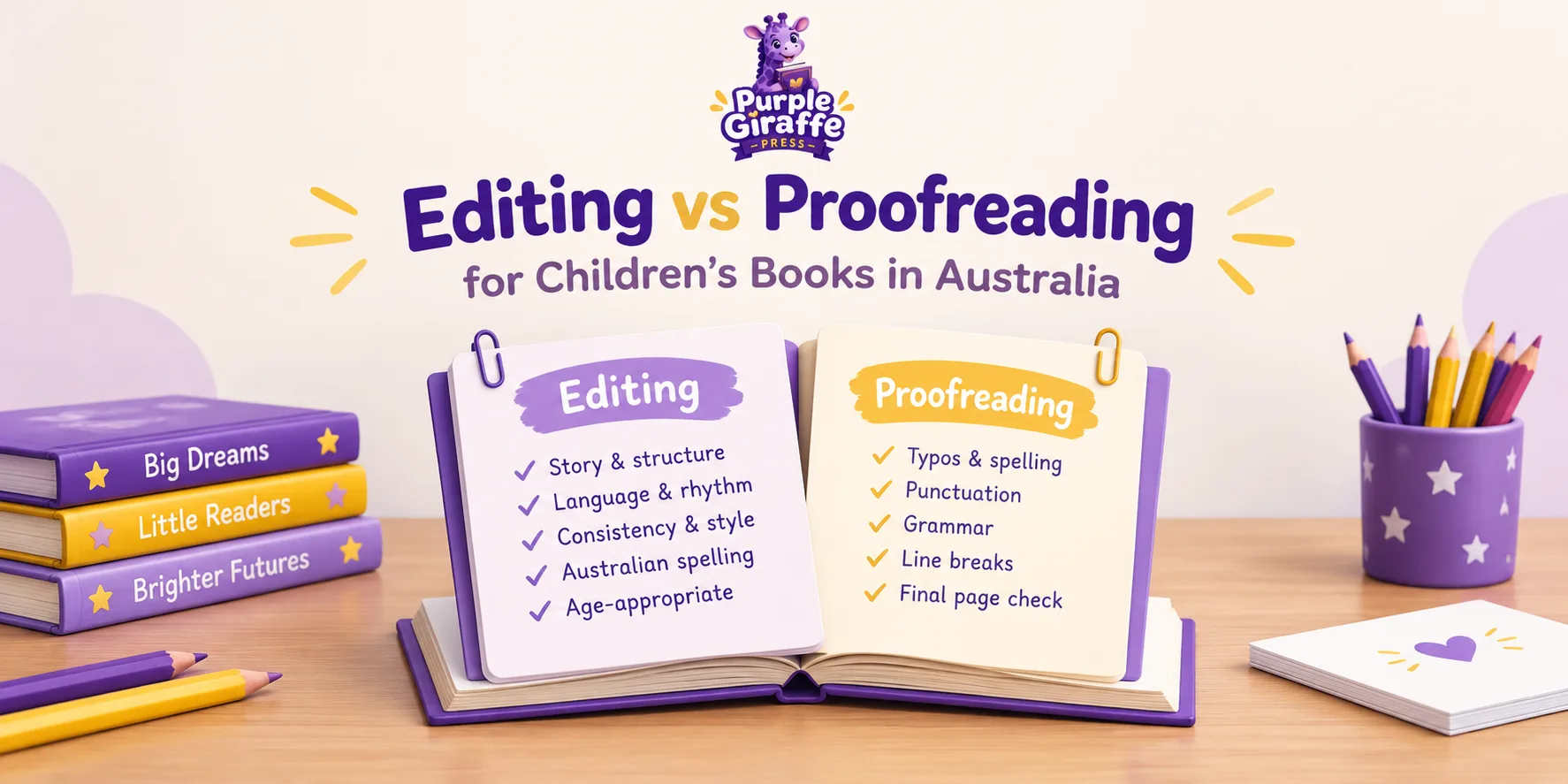
Age-band awareness, read-aloud rhythm and vocabulary control are craft skills a generic adult-fiction editor won't carry. Our children's book editors in London page shows what to look for in a brief. If you're unsure whether you need an editor or a proofreader (two different jobs with two different price logics), our side-by-side on editing vs proofreading for children's books sorts it out quickly. For a worked example of a micro-decision a copyeditor settles, see our note on ingrained vs engrained.
Proofreading
Proofreading is the last error pass, after copyedit and typesetting. It catches the stray double space, the orphaned line break at the top of a page, a hyphenation call the layout software made automatically, and the inconsistent character name that only shows up once the text is set in position.
For a picture book, proofreading is light on word count but demanding on attention. Every spread needs reading at the typeset stage, not from the manuscript. Text that works on screen can land badly when it wraps around an illustration, slips into a gutter, or breaks across a page turn in the wrong place. For chapter books and middle grade, you're also checking widow and orphan lines (lonely words or lines stranded at the top or bottom of a page). Our children's book proofreading services in London handle exactly this stage.
Illustration: The Biggest Variable
Illustration is almost always the single largest line item in a children's book budget, and the one with the widest honest range. The phrase "illustration cost" is misleading because it bundles several priced things into one word.
Here is what moves an illustration quote. Page count: a 24-page picture book costs less than a 48-page one. Number of full-colour spreads. Number of spot illustrations, chapter openers and endpaper art, each with its own hourly logic. Number of named characters: a character sheet with front, side, back and expression range costs more than one hero in one pose. Colour versus line: full colour costs more than line and tone, which costs more than silhouette. Whether the illustrator supplies a paid style sample before commissioning (standard practice, keeps both parties out of trouble). And the rights model, which deserves its own paragraph.
The rights question is the one most authors miss until contract time. A buyout gives you full ownership for future editions, translations, merchandising and screen adaptation. An exclusive licence is cheaper but restricts your later use. A non-exclusive licence is cheaper still but means the illustrator can resell the style elsewhere. For a book you intend to grow into a series, a buyout almost always pays for itself. Our children's book illustration service in London scopes a brief against exactly these choices.
A quick note on AI-generated illustration, because it comes up now in every planning conversation. The main UK ebook retailers require authors to disclose AI-generated images at upload, and the legal position on copyright protection for purely AI artwork in the UK remains unsettled. Treating AI as a free shortcut without reading its terms is the fastest way to publish a book you can't later defend.
Interior Design, Cover Design and Formatting
Interior design, cover design and formatting are three separate crafts. Interior design lays out your text and illustration spread by spread, matching read-aloud flow with page turns and placing text where a child's eye naturally lands. Cover design covers the front, spine, and back, built with trim and bleed set for the printer you plan to use. Formatting converts your finished files into print-ready PDFs for paperback and hardback, ePub for ebook retailers, and the metadata-compliant source files the UK's ISBN agency needs for registration.
Picture-book layout is a specialist craft. Standard adult typesetting software and templates don't do it well: text sitting under or around a full-bleed illustration needs to be judged visually, not algorithmically. Our professional children's book design in London page shows what that approach looks like.
Formatting is often the stage where a project runs over, because the same book usually needs several format files. An ebook needs reflowable layout, a paperback needs fixed layout with bleed, a hardback has its own case dimensions, and the audiobook needs a clean master script. Our children's book formatting services in London page covers the full file list.
If you're still choosing a trim size, our picture book format explainer covers the trade-offs between square, portrait and landscape, including what each does to your production budget.
ISBN Registration and Legal Deposit
Nielsen Book Services is the single ISBN agency for the UK and Ireland. There is no alternative. Every format of your book (paperback, hardback, ebook, audiobook) needs its own ISBN, because retailers and libraries treat each as a separate product.
The single-versus-block decision is more consequential than it looks. A single ISBN is cheaper up front but inflexible: you'll need another the moment you publish a second edition or a different format. A block of ten is better value per unit, and almost every author who plans more than one book or format benefits from buying a block from the start.
The "free ISBN" question comes up often. The main US-headquartered self-publishing platforms will issue an ISBN at no cost, but that ISBN lists the platform as the publisher of record in global bibliographic databases, not you. For a London author aiming at UK bookshops, UK libraries and UK press coverage, publisher-of-record status matters more than the ISBN price. If you register your ISBNs under your own imprint, you own that record for the life of the book.
Legal Deposit is a separate obligation written into UK law, and generic guides skip it. Within one month of publication, you must send one copy of your finished book to the national Legal Deposit office at Boston Spa in West Yorkshire. The deposit agency acting for five further national and university libraries may then request additional copies for the Bodleian in Oxford, Cambridge University Library, the National Library of Scotland, the National Library of Wales, and Trinity College Dublin. This isn't optional, and it isn't a price-based service, but it is a planning cost (postage, extra print copies) you should fold in.
Printing: Print-on-Demand, Offset, Paperback, Hardback, Board
Print choice splits across two axes: method and format. On method, you choose between print-on-demand (every copy printed as it's ordered, no stock risk, highest per-unit cost) and offset (a bulk print run, lowest per-unit cost, highest upfront cash call, warehouse logistics to think about).
For a London author starting out, print-on-demand is almost always the right first move. It lets you learn how the book sells before committing to stock, handles global orders through established retailer pipes, and keeps the project a side-of-desk endeavour rather than a logistics operation.
Offset becomes worth considering once you have school visits booked, local independent bookshops asking to stock you, a Christmas-market stand lined up, or confirmed library purchase lists. The per-copy maths shifts hard once you're ordering five hundred at a time.
Format choice sits alongside method. A paperback carries the lowest per-copy cost and the widest retailer acceptance. A hardback costs more per copy but holds its price point better and gives you something giftable for the Christmas and birthday markets children's books live and die on. A board book is a specialist job: usually offset-only, aimed specifically at the under-threes.
A critical note for picture-book authors: colour interior print-on-demand is materially more expensive per copy than monochrome. If a printer or packager quotes you based on a monochrome assumption, that number will not survive contact with your actual book. Our children's book printing services in London page outlines how we scope print to the format you've chosen.
Audiobook and Marketing
Audiobook production is optional, not obligatory. For picture books, the audio experience is a parent reading aloud, not a professional narrator, so audiobook versions are rarer at that age band. For middle grade and young adult, audio is increasingly how reluctant readers find your book.
The real drivers of audiobook cost are narrator day rate or per-finished-hour rate, studio time, direction, editing, mastering, and distribution setup to the main audio retailers. A longer book costs more. A multi-narrator cast costs more. Original music or sound design costs more. Our London trusted audiobook production experts page covers how we scope these.
Marketing is its own long topic, treated more fully in a separate guide. For now, the cost drivers worth naming are author website, email list, advance review copies, launch event (physical or online), paid digital advertising, press pitching, book trailer, and book-trade metadata optimisation. Our children's book marketing services in London page gives the full scope. If you want to add a trailer to your launch toolkit, our London children's video book trailer service shows what that involves.
What Should a London Author Budget, Realistically, for a Children's Book?
Most London children's authors land in one of three honest budget situations: a shoestring, do-it-yourself-heavy launch, a modest self-funded release with a few professional elements, or a fuller professionally managed project. Which one fits you depends on your available cash, your available time, your format, and how much of the craft work you can realistically do to a publishable standard yourself.
The shoestring tier assumes a self-written manuscript, a critique-partner proofread rather than a paid one, a cover built in a free design tool, a Kindle-only release or short print-on-demand run, and all marketing done by the author in their own time. This tier is realistic for a chapter book or middle-grade story where art demands are low. It is almost never realistic for a professionally illustrated picture book. If you try, the book will look what it is: a project done on a shoestring. That shows at the till.
The modest, mostly self-funded tier adds a paid copyedit and proofread, a sensibly priced illustrator or part-illustrated interior, a block of your own ISBNs registered under your own imprint, print-on-demand paperback distribution, a simple author website and email list, and a controlled Amazon ad experiment. This suits an author with some savings, moderate time, and a willingness to project-manage. Your author presence is the asset that carries over to every future book, so building a decent children's author website design in London early pays off across your backlist.
The fuller, professionally managed tier covers a ghostwritten or heavily developed manuscript where that's needed, a full editorial stack, a professional illustrator with buyout rights, both hardback and paperback print formats, an audiobook, a proper author website, a book trailer, press outreach and a paid campaign. This tier suits an author with real cash to deploy, who wants a team to run the operation and give them time back for the next manuscript.
A plain word most guides leave out: bigger spend does not guarantee bigger sales. A well-illustrated, well-edited, well-targeted modest release routinely outperforms a heavily funded release aimed at the wrong age band or launched in the wrong season. If you're torn about where to pitch your budget, ask yourself first whether you have a specific reader in mind. If you can picture the five-year-old your book is for (what they already like, where their adults shop for books, what they ask for at bedtime), your money will land better than if you can't.
Readers often ask how UK figures compare with Ireland and the United States, because the cost conversation sounds different in each market. Our companion guides on the cost to publish a children's book in Ireland and the cost to publish a children's book in the USA use the same methodology and let you see where sterling, euro and dollar thinking sits alongside.
What Do UK Children's Authors Need to Know About VAT, Royalties and Tax?
UK children's authors need to know four things: the finished book itself is zero-rated for VAT, the publishing services that produce it are standard-rated, the Public Lending Right scheme pays for every loan from a UK public library, and a secondary-rights royalty scheme (ALCS) collects photocopy, educational and overseas-library income that most self-publishers never claim. None of this tends to appear in generic self-publishing guides, and each has pound consequences across the life of your book.
The UK VAT Split: Zero-Rated Book, Standard-Rated Services
Under HMRC's long-standing rule set, printed books, children's picture and painting books, and (since the law changed in May 2020) their electronic equivalents are all zero-rated for VAT. The author is not charged VAT on the sale of the finished book itself. HMRC's VAT Notice 701/10 is the live reference and worth reading before you plan.
Service invoices are a different story. An editor's bill, illustrator's bill, formatter's bill, designer's bill, marketing invoice and audiobook producer's invoice all carry VAT at the standard rate if the supplier is VAT-registered. Not every freelancer is VAT-registered, so some invoices arrive without it. A budget that doesn't allow for the VAT-inclusive figure will land you short by a meaningful amount. The simplest check at quote stage is to ask directly: "Is this quote inclusive or exclusive of VAT?" The answer tells you both the number and something useful about the supplier's professionalism.
The Public Lending Right Scheme
Public Lending Right is a UK scheme that pays authors, illustrators, editors, translators and audiobook narrators a small amount for every loan of their book from a UK public library. Registration is free, and the right starts generating income the moment your book is in library circulation.
The practical point for a London author is that children's books get borrowed heavily. Teachers, nursery staff, grandparents and parents on the weekday run to the local library all borrow from the children's shelves. If your book carries an ISBN, sits in UK public libraries, and you are UK-resident, there is income here you are entitled to that nobody will remind you about.
ALCS and Secondary Rights
The UK runs a secondary-rights royalty collection scheme (commonly known by its initials, ALCS) that collects income from photocopying in schools and universities, educational licensing, overseas library loans, and various other secondary uses of your written work. Registration takes minutes and sits quietly in the background, generating income once your work is listed.
For a children's author whose book finds its way into schools, nurseries or university-level teacher training, this income can be surprisingly steady. Most self-published children's authors never register and never see the money.
Income Tax and Deductible Costs
Book royalties and author income are normally treated as self-employment income for UK tax purposes. There is a small government-set trading allowance below which casual income does not need to be declared. Beyond that, your writing income is reportable through self-assessment, and your editing, illustration, formatting, design, printing, ISBN, marketing and author-related travel expenses are generally deductible against that income.
This is the stage at which a conversation with an accountant who has seen author accounts before is worth more than it costs. The rules are not complicated, but applying them cleanly across a first-year release, royalty back-payments, PLR arrivals and secondary-rights payouts needs someone who has done it before.
Public Arts Funding
The UK runs a public arts funding programme that explicitly supports writing and illustration for children and young people, among many other project types. Grants are competitive, aimed at the creative work rather than at routine marketing or production, and come with specific guidance about what they will and won't support. If you're thinking of applying, the time to read the current programme guidance is before you plan the book, not after.
Where Can London Authors Get Free or Low-Cost Children's Book Publishing Support?
London children's authors have real, free and low-cost support available through public libraries, free writer community groups, public arts funding, independent bookshop launch opportunities, and the capital's annual publishing trade event season. None of this replaces editing, illustration, or printing budgets, but it lowers the amount of paid marketing and credibility-building you have to buy before launch.
Public libraries in London are an underused research resource. Reader passes to the national research library on Euston Road are free and give you a quiet workspace, free Wi-Fi, and access to a children's book archive useful to anyone writing in the age band. Local libraries across London's boroughs run author events, workshops and children's book sessions you can observe to understand what your age band is actually reaching.
Free writer community groups are another real resource. Across the capital, critique circles meet weekly or monthly in cafés, upstairs rooms of pubs, library meeting rooms and community spaces, often for the price of a coffee. A group that specifically works on children's manuscripts gives far more useful feedback than a general-fiction circle, because the age-band questions are different.
Public arts funding is another route worth knowing about. The UK runs a project-grant programme that explicitly includes writing and illustration for children, with a rolling application process. The money comes with structure (application form, project plan, budget, outputs) which some authors find useful and others find off-putting. If your book has a strong public-good angle, this is worth reading up on well before you plan.
Independent bookshops in London regularly host children's book launches for local authors. The arrangement is usually that the shop sells copies on the night and takes a standard retailer margin. You bring the audience; they bring the venue and the sales infrastructure. The result replaces the cost of hiring a venue and provides credibility that spends well in press releases. Approach the shop as early as a season or two before launch, and treat the first conversation as a mutual-fit meeting, not a booking request.
London's annual publishing trade event season, held at Olympia each spring, is open to anyone willing to pay for a day pass, and it is the single densest afternoon of the children's book industry you can get in the UK. Even if you buy no services on the day, the sense of the market, the age-band shifts, and the conversations about what's selling will reshape your own planning.
A final honest word. Free support does real work, but it works best as groundwork for your paid team, not a substitute. A London author who writes from a critique group, uses library research to sharpen their non-fiction, applies for public arts funding for a workshop series, and launches at a local bookshop will still, when the time comes, want a professional editor, a professional illustrator, and a proper print setup. The free side builds the author; the paid side builds the book.
How Do You Spot a Children's Book Publishing Quote That's Not Worth Paying For?
A children's book publishing quote is worth questioning if it guarantees bestseller status, bundles everything into one lump sum with no itemised breakdown, won't name the ISBN registrar, won't confirm the illustrator's rights model, or can't tell you who will be listed as the publisher of record once the work is done. The signals below are specific enough to use in a first phone call with a prospective supplier.
Any guarantee of bestseller status, retailer stocking, a specific Amazon ranking, a confirmed school-visit income or a set number of sales is a red flag. No legitimate publisher or author-services provider can guarantee reader behaviour. Promises of this kind are either marketing language used sloppily or, worse, a straightforward overclaim. Ask follow-up questions and watch how the supplier responds under light pressure.
Ask for an itemised breakdown of a bundled figure. A reasonable breakdown names manuscript development, each editorial pass, illustration (by type), interior design, formatting, ISBN registration, Legal Deposit handling, print setup, cover design, metadata preparation, marketing and audiobook (if included). A supplier who won't itemise is either disorganised or hiding cross-subsidy from one line to another.
Ask who will be listed as publisher of record when the book goes to Nielsen. If the quote includes a "free ISBN" without clarifying this, the aggregator supplying it will be publisher of record globally, and your name will not appear in the bibliographic database libraries, bookshops and trade press use. For a London author who wants to be stocked in UK bookshops, that matters.
Ask about the illustrator's rights model up front, and get the answer in writing. Buyout gives you full ownership. Exclusive licence sits in the middle. Non-exclusive licence restricts your later use. A supplier vague here is signalling the illustrator contract they use is not working on your side.
Be wary of pressure to pay a large upfront retainer before you've seen a specific plan tied to your book, your age band, your target format and your budget. A respectable supplier gives you a scoped proposal before asking for commitment. Someone pushing for a signed contract in the first conversation is working on a sales target, not on your project.
Finally, confirm whether a figure is VAT-inclusive or VAT-exclusive. Ask directly, in writing. Suppliers who are VAT-registered will tell you plainly. Suppliers who dodge the question are a reason to pause.
How Can You Tell Whether Your Children's Book Publishing Spend Is Paying Off?
Judge your publishing spend against a specific goal you set before launch, not against vanity metrics, and review at honest checkpoints across the first year. Royalties, Public Lending Right income, secondary-rights payouts, school-visit fees, and backlist pull-through together form the actual return. One Amazon ranking screenshot taken on launch week forms almost none of it.
Set the goal before you spend. If your goal is first-year sales, measure first-year sales. If your goal is school and library visibility, measure library holdings and school visit requests. If your goal is building an audience for book two, measure email list growth and social following. Mixing these up produces vague answers and bad decisions about where to put money next.
Track attributable results properly. Sales reports from your retailer platforms, book-trade data where you can get it, your Public Lending Right annual statement, your secondary-rights royalty statements, tagged links in email and ad campaigns, and attribution questions asked at events. Attribution in children's books is particularly unclean, because a reader often first encounters a book through a librarian, a parent group or a school visit and buys months later through a different channel.
Compare net earnings against the full publishing spend, not just your advertising bill. Use what you actually retain per sale (after retailer, distribution and printing deductions), not the recommended retail price. Add royalty income, PLR, secondary-rights payments and event income on one side. Add every pound spent on manuscript, editing, illustration, design, formatting, printing, audiobook, website and marketing on the other.
A simple thought experiment helps. If your total publishing spend is a known figure, and you retain a known amount per copy, dividing the two tells you how many copies you need to sell to recover the money. Treat it as a reality check, not a forecast. Books that take two years to break even are normal in children's publishing, especially for a first title building a backlist.
Review at honest checkpoints: three months, six months, twelve months. Continue what the evidence supports. Adjust what's underperforming. Pause what's not working. Carry the lessons into your next book's budget. The second book is almost always cheaper to publish than the first, because the systems are already in place.
Ready to Publish Your Children's Book in London?
The next step is a direct conversation about your book: the age band, the format, the illustration load, the realistic budget, and the timeline. A tailored plan beats a generic package every time, because your book is not a generic project and your budget is not a generic budget.
At Purple Giraffe Press, we work with London children's authors on exactly that conversation. Whether you're writing your first picture book, planning a middle-grade series, or working out whether your manuscript is ready for an illustrator at all, a scoping call will give you a clear sense of what the project needs, what it doesn't, and what a reasonable sequence of steps looks like. Write to us for a tailored proposal rather than a figure, and we'll come back with a plan matched to the book you actually want.
Ready when you are
Let's bring your children's book to life.
From a first idea to a finished book children adore, we are with you at every step. Tell us about your story and we'll reply within one business day.
Start Publishing →