A hardback children's book is a text block bound into a rigid case, usually with a printed paper-over-board finish and sometimes a separate dust jacket. A paperback children's book is a text block perfect-bound into a flexible laminated cover, trimmed flush with the pages. For an Australian author deciding between the two, the useful question is not which format sits on which shelf. The useful question is which binding serves this specific book, this specific reader and this specific pattern of use, and whether a single edition is enough or a second edition genuinely earns its production work.
By the time an author reaches that decision, an illustrator may already be inking spreads to a specific trim size, an editor may have shaped the manuscript to a particular page count, and a cover designer may have mocked up versions against a particular format. Binding looks like a late production step. It reaches back into every earlier decision, because it changes the spine width, the cover file template, the endpaper question, the gutter allowance and the way a double-page spread meets the middle of the book.
Australian children's publishing has its own patterns around this choice, and they do not always follow what overseas blog posts describe. Australian adult trade publishing leans towards launching in paperback rather than hardback first. Australian children's publishing is more varied: many gift and award-aspirant picture books launch in paper-over-board hardback, many series and middle-grade titles launch in paperback, and board-book titles for the under-threes sit in their own binding category that is not interchangeable with hardback at all.
If you want a tailored view on your project, children's book publishing support for Australian authors is where that conversation happens. The rest of this piece gives you what you need to carry into it.
What is a hardback children's book?
A hardback is first a construction, and only secondly a commercial format. The text block is folded into signatures, then either sewn through the fold or notched and glued, and the whole block is cased into rigid boards wrapped in a printed cover. The boards sit slightly wider than the text block to form a small overhang, which is why a hardback stays off the page edges on a shelf.
Two finishes dominate Australian children's hardbacks. Paper-over-board, also called casebound with a printed case, wraps the laminated artwork directly over the boards; the illustration meets the eye without a separate wrap. Cloth-with-dust-jacket covers the boards in buckram or paper and carries the main cover design on a removable jacket. Paper-over-board is the default for most trade picture books aimed at the gift and library readership, because the artwork lives on the hard cover itself and will not slip off during reading. Dust jackets still appear on premium editions and some illustrated non-fiction.
The cover does more than carry the artwork. Rigid boards hold the text block square when the book is left spine-down or crammed into a kinder bookshelf. A sewn text block inside those boards opens more fully near the gutter than a glued block does, which affects how a double-page illustration reads. A rigid cover is not the same as a sewn interior; some hardbacks sit a perfect-bound block inside a hard case, which saves production time at the cost of opening behaviour. That combination reads differently in the hand from a sewn case binding.
A hardback is not automatically more durable at the page level. It carries stronger cover protection, not stronger paper. Pages still tear and absorb spills unless the paper stock and the lamination account for the use pattern. If the book will land in the hands of a reader who treats pages as the main point of failure, custom children's book illustration is only the start of the work; the paper and binding brief protects the finished art.
What is a paperback children's book?
A paperback is a text block held together at the spine by adhesive or by notch binding, wrapped in a single laminated cover trimmed to the same size as the pages. The cover is flexible and Hardback and paperback compared on the dimensions that affect the decision takes most of its structural rigidity from the lamination on the printed stock, usually matte, gloss, or soft-touch.
Two binding approaches sit inside the paperback category. Perfect binding uses polyurethane reactive adhesive (PUR) to hold the pages, with the spine ground flat before glue is applied. PUR is the modern standard for children's paperbacks and holds up well against the flexing a read-aloud picture book takes in a classroom. Notch binding keeps the signatures intact and pushes glue into small notches cut along the spine, which improves lay-flat behaviour at the cost of a more involved production step. If your paperback edition will be read aloud across a wide spread, notch binding is worth asking for in a quote.
French flaps extend the front and back cover inward, giving a trade paperback space for flap copy and a visual nod to the hardback's dust jacket without the slip risk. They add a step at the folding and trimming stage and are a common finish on Australian children's paperbacks pitched into the gift market as a softcover alternative.
Paperbacks reach readers in volume. They sit well in a backpack, stack easily for a school talk and tolerate the reorder-small, reorder-often rhythm of a growing readership. They also reveal manuscript quality more honestly than a hardback does, because the physical presentation carries fewer gift-market cues. Clean editorial work earns its keep in a paperback edition, which is why professional editing for children's manuscripts is the layer that makes writing hold up under direct reading.
The texture of language in a picture book is a decision an author carries into every proof. A sense of what is imagery in a children's book shapes how a softcover launch reads aloud, and whether the writing holds the weight the format asks it to.
Related terms: casebound, paper-over-board, board book, dust jacket, library binding
Several words get used interchangeably, and a few describe genuinely different things.
Hardback and hardcover are the same product in current Australian usage. Casebound is a production term for binding the text block into a rigid case; all hardbacks are casebound. Paper-over-board describes the finish where the printed paper cover wraps directly over the boards, with no separate dust jacket. A dust jacket is the removable printed paper wrap on a cloth or boards hardback; it carries flap copy and often a quieter cover design than the boards underneath.
A board book is a separate binding category, not a kind of hardback. Each page is printed on heavy board stock around a millimetre thick; the pages are laminated for tear and chew resistance, and the book is bound with short glued sections and sometimes rounded corners. Board books serve babies and toddlers under three, and they handle a style of use (teething, dropping, chewing) that neither a hardback nor a paperback is built for. A hardback edition of a picture book is not a substitute. A board edition of a successful picture book is a second project, with a different trim size, page count, and design brief, not a reprint.
Library binding is a reinforced construction used mainly by specialist suppliers to extend the working life of a title in a public or school collection: sewn text block, buckram cloth covers and reinforced endpapers. Most Australian authors never commission a library binding directly; it is more often added by a library supplier after acquisition, when a title is heading into heavy institutional use.
If a collaborator pitches you an edition described in a mix of these words, ask for the specification in writing: trim size, page count, board thickness, paper weight, cover finish and binding method named. Proofreading for Australian children's books applies to the manuscript; the production brief needs its own careful read.
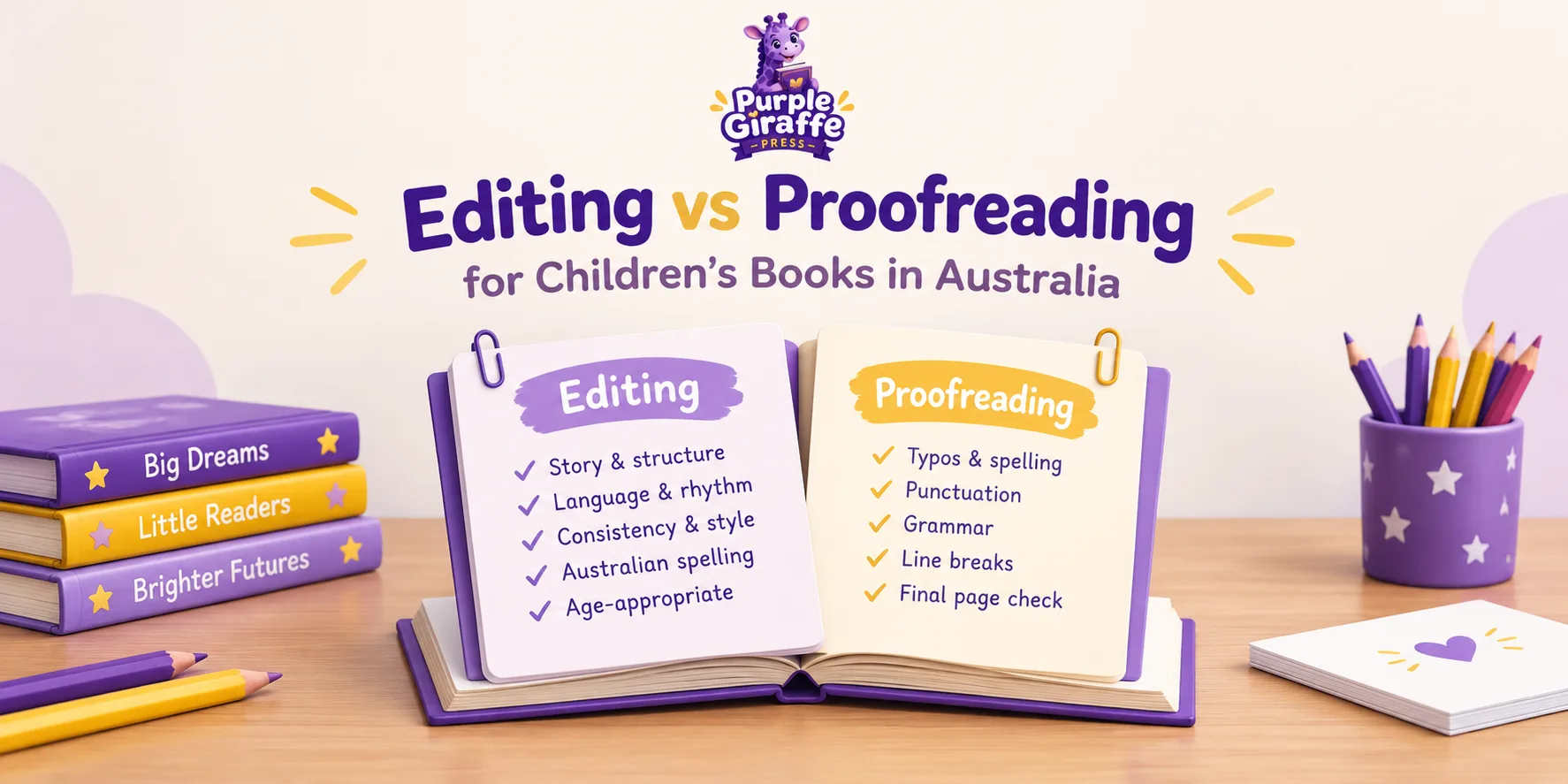
The order of editorial work matters here. A short read on editing vs proofreading for children's books sets out which stage catches which problem, and the binding decision is best made after structural editing is settled.
Where a collaborator has also offered writing support, ghostwriting for children's authors is a related conversation that sits separately from the binding question.
Hardback and paperback compared on the dimensions that affect the decision
The comparison that actually helps is not a feature list. It names the dimensions where the two bindings diverge and marks what the author can verify with their own eye and hand against what needs the printer's written confirmation.
Dimension | Hardback | Paperback | What to verify |
Construction | Rigid boards wrapped in a printed case, with a sewn or glued text block cased in; endpapers front and back. | Flexible laminated cover; perfect-bound (PUR) or notch-bound text block, trimmed flush. | Confirm sewn vs glued text block in the quote; a glued block inside hard boards reads differently from a sewn one. |
Portability | Heavier in the hand; sits better on a lap or table than in a bag. | Lighter and bag-friendly; suits a backpack, satchel or school-visit box. | Weigh a proof copy; listed printer weights sometimes assume a thinner stock than the final run. |
Cover durability | Rigid boards resist impact, stacking and bending; cover holds the block square. | Flexible cover bends under pressure; may acquire a permanent crease along the front panel. | Lamination weight and finish; ask for printed cover stock gsm and the laminate type. |
Page durability | Not improved by the rigid case; page strength is a paper decision. | Also governed by paper choice, not by the cover. | Interior paper gsm, coating (matte, silk, gloss) and opacity; hold a proof page to the light. |
Spread visibility | A sewn hardback opens closer to flat and loses less illustration at the gutter. | A perfect-bound paperback holds a stiffer gutter and swallows more of a spread, especially early in a title's life. | Open a proof at the middle, quarter and three-quarter points; measure gutter loss against the illustrator's safe area. |
Finish options | Paper-over-board or dust-jacketed; matte, gloss, soft-touch laminate; spot UV, foil, debossing and embossing all workable. | Matte, gloss, soft-touch laminate; spot UV common; foil and debossing less common but available. | Ask for a printed sample of the finish on the actual cover stock; laminates read differently on different papers. |
Reorder behaviour | Higher setup effort, longer lead time at the printer, typically reorders in larger batches. | Lower setup effort, shorter lead time, reorders faster at smaller volumes. | Request lead-time estimates for a range of reprint volumes; compare across quotes. |
Production implications | Separate cover file with wrap allowance, endpapers, dust-jacket design where used; longer press and bindery schedule. | Single flat cover file with spine band and optional flap allowance; shorter production schedule. | Confirm cover templates against the printer's current specifications; templates change. |
Construction governs every other row. A rigid-cover book with a glued text block will still fail at the gutter under enough flexing, and a sewn paperback with no board can lie flatter under a classroom reader than a rigid book with a tight perfect-bound spine. The decision is layered, not binary.
Portability sits with the reader's hand and the use pattern. A middle-grade novel carried in a primary-school bag across a term lives inside a flexible cover more comfortably than inside rigid boards. A read-aloud picture book shared from an adult's lap across a group of children needs a cover that stays rigid when held at an angle; that is a hardback's natural job.
Durability belongs in two columns, not one. Cover durability answers whether the book survives being dropped, sat on, or stacked. Rigid boards win on that. Page durability answers whether the paper tears, buckles, or stains, and it is governed by paper weight and coating rather than binding. A well-specified paperback on a heavier matt-coated stock can outperform a cheaper hardback on thin uncoated text paper under daily toddler use.
Spread visibility is the dimension most authors underestimate before their first proof arrives. A double-page illustration crosses the gutter, and the binding governs how much of the picture the reader sees. A sewn hardback with a well-engineered spine opens close to flat and keeps the gutter loss within the illustration's margin of forgiveness. A perfect-bound paperback with a shallow gutter allowance will swallow a strip of artwork in the middle, and anything important in that strip will disappear.
Finish options read differently across the two. Soft-touch laminate feels sophisticated on both. Spot UV sits well on paperback covers, where the contrast between matte and gloss carries at eye level. Foil stamping is more common on hardback, because heat and pressure sit better on the rigid board.
What to verify with the printer is the right question for every row. Paper weight, paper grain direction, opacity under full-colour printing, binding method, board thickness, endpaper stock and lamination weight belong in a quote in writing, not in assumptions carried from a previous title. For a broader read on the production side, children's book printing covers the setup end of that conversation.
Trim size interacts with binding at every stage. A short orientation on picture book format explains how trim and page count work together before binding enters the conversation, which is the order most authors find useful.
One qualifier applies to the whole table. Blanket statements about which binding is more durable, better value, or sturdier miss the relationships above. Each dimension depends on specifications you verify before you print, not on the binding word alone.
The Australian release pattern is category-specific, not hardback-first
Australian children's publishing does not follow a single release model. The common overseas assumption that a title appears in hardback first and migrates to paperback a year later holds in some corners of the Australian market and not in others.
Picture books aimed at the gift and library readership often launch in paper-over-board hardback, with a paperback appearing later as the backlist edition or the book-club-friendly reprint. The gap between editions varies. Some titles never receive a paperback at all, because the imprint judges the hardback carries the whole life of the book. Others land in simultaneous editions when the imprint wants to open both the gift market and the trade market at once, usually around Christmas or Book Week.
Middle-grade and young-adult fiction more commonly launch in trade paperback. A hardback edition of a new middle-grade or young-adult novel is uncommon in Australia; exceptions are mostly flagship series, international co-editions or gift-timed releases. Early-reader chapter books and series almost always launch in paperback: short books read aloud at home, bought in batches, kept in a classroom reading corner.
Board books launch in board. There is no paperback or hardback equivalent for the under-threes. A title that succeeds in picture-book hardback may receive a separate board edition later, redesigned around a smaller trim, a different page count and a simpler narrative pace.
Illustrated non-fiction for older readers tends to launch in hardback, because the format sits well with the school-library brief and the gift-book presentation; paperback editions appear where the imprint wants a cheaper school-set version alongside the library edition.
Authors who come to the decision expecting hardback first, paperback later to apply are often responding to American industry commentary describing a different retail and library market. The Australian pattern is category-specific and imprint-specific. A direct question to the acquiring editor or hybrid partner about the house's own release pattern for a book like yours is more useful than any general rule.
Durability is three separate questions, not one
Durability is the dimension authors ask about first, and the one they often oversimplify. It helps to separate three claims before picking a binding.
Cover durability is what most people mean by sturdier. A hardback with rigid boards keeps its shape when the book is dropped, sat on, or stacked. A paperback with a flexible cover bends under the same force and may acquire a permanent crease along the front panel. For a title intended for gift and library use, cover durability is a real advantage of hardback.
Page durability is a separate question. A rigid cover protects pages from external impact but does not change how those pages respond to tearing, crumpling, folding or spills. Page durability depends on paper weight (in grams per square metre), coating, fibre composition and the age of the reader. A heavier matt-coated paper (commonly 150 to 170 gsm for a picture book interior) resists tearing more effectively than a lighter uncoated stock, regardless of whether the pages sit inside boards or inside a flexible cover.
Use pattern pulls the first two together. A picture book shared on an adult's lap for ten minutes a night across a year faces different demands from a board book handled unsupervised by a twenty-month-old, and both face different demands from a middle-grade novel carried in a backpack. Matching binding to use is sometimes about choosing the stronger format and sometimes about choosing a different format category entirely. A board book is not a stronger picture book; it is a different product for a different reader.
Protective finishes resist some forms of damage but not all. Matte and gloss lamination make a cover more resistant to small spills, surface scuffs, and finger grease. Soft-touch laminate holds up less well to abrasion but reads more premium to the hand. None of these finishes make a book waterproof. A finished cover absorbs a sustained spill, and interior pages absorb liquid through the trim edge regardless of what the cover does. If a title's use genuinely involves wet environments, the right product is a specialty format built for that use, not a hardback with a glossier cover.
No handling check performed by an author on a single copy replaces compliance testing. Australian consumer law treats children's products as a specific category, and physical safety testing, particularly for books aimed at infants and toddlers, is a matter for the manufacturer and importer. Observations about how the book feels in the hand are useful at proof stage; they are not a product safety sign-off.
Opening behaviour, paper grain and the gutter problem
Opening behaviour is the single technical dimension that most affects whether a picture book reads well in the hand, and the one authors most often notice only at proof stage.
A book opens flat when its binding allows the spine to relax enough that the two facing pages sit near-parallel to the reading surface. It depends on binding method, paper weight, paper grain, number of pages, and the age of the glue. A new perfect-bound paperback with a short page count and a stiff cover will open with resistance for the first few reads and relax over time. A sewn or notch-bound hardback with grain running parallel to the spine will open closer to flat from the first read.
Grain direction is a detail many authors never see on a printer quote but should ask about. Paper has a grain set by the direction of the fibres during manufacture, and for a bound book it should run parallel to the spine. If a printer prints a short-grain book on long-grain stock to save paper, the pages fight the binding every time the book opens, and the book never relaxes into a comfortable spread. The symptom at proof stage is a book that seems to resist opening past a shallow angle.
Gutter allowance is the design decision that pairs with binding. A sensible gutter allowance for a picture book typically runs between 10 and 20 millimetres of safe area on each side of the spine, depending on the binding. A hardback with a sewn block that opens flat tolerates a smaller gutter allowance before anything important disappears. A perfect-bound paperback with a shorter run and a stiff cover needs a wider safe area, because the gutter loss at first reads is greater. A character's eye drifting into the gutter is the proof-stage problem most authors eventually see.
Decisions around spreads should be made at the thumbnail stage, not during final art, and the illustrator should know the binding before the gutter is set. If the binding changes after final art, the files may need to be adjusted to protect the composition, and that is time and cost nobody budgeted for. For a wider view of how art and binding relate across a picture book, children's book illustration sets out the stages where gutter, trim and binding have to speak to each other.
The honest answer to "can we decide later?" is only if the illustrator has set a gutter margin that works for either binding. A conservative gutter allowance costs a little composition on a flat spread and buys the flexibility to run either binding later.
Format by book type and use
Different children's book types take different bindings for reasons that connect to the reader, the shared-reading use, the production constraints and the retail route.
Book type | Reader need | Plausible format | Reasoning | What could change the choice |
Toddler book for independent handling (0–3) | Chewable, drop-resistant pages; rounded corners; short page count. | Board book. | Paper pages fail under this use; a hardback cover does not help pages that tear. | If the book is intended for shared reading with an adult rather than independent toddler handling, a hardback picture book may serve better. |
Read-aloud picture book shared on a lap (3–6) | A rigid cover held at an angle, pages that survive repeated turning, spreads that read across the gutter. | Paper-over-board hardback as the launch edition; paperback as a follow-up. | Rigid boards keep the book square at the adult's holding angle; a sewn block opens closer to flat so the illustration reads across the spine. | A tight launch budget or a schools-first distribution route may point to a paperback-only launch. |
Early reader and junior chapter book (5–8) | A book the reader handles alone, carries in a bag, reads over several sittings. | Trade paperback. | Weight, portability, and series economics sit with paperback; a hardback edition rarely earns the format in this bracket. | A flagship series or anniversary edition may support a hardback alongside the paperback. |
Middle-grade fiction (8–12) | A longer text block, self-managed reading, often re-read across years. | Trade paperback. | The Australian retail and library pattern in this category is set around paperback; the reader handles the book alone and weight matters. | A simultaneous hardback for a Christmas gift release or a flagship series title may appear. |
Illustrated non-fiction for middle grade (8–12) | A book that survives school-library circulation, reads well across spreads, sits in a gift-book slot. | Hardback, often with a paperback follow-up for school-set sales. | The illustration investment and the library brief both favour hardback; a paperback follow-up opens the broader classroom-set readership. | A single-edition launch in paperback can still work for a tighter budget or a schools-first distribution plan. |
A title for toddlers to handle independently needs a board book. The reader cannot be relied on to turn paper pages without tearing them, cannot hold a hardback open without crumpling pages, and will often chew the corners. A hardback is not a substitute. If the manuscript was written as a picture book for shared reading and the author now wants the child to handle it alone, the sensible next step is a conversation about whether this is a picture book reduced to board or a different, shorter manuscript built for board from the start. For orientation on what is a picture book in Australian terms, the question of where picture books end and board books begin is useful to settle before committing to files.
A read-aloud picture book for a parent sharing a large illustrated spread with a preschooler usually sits best in paper-over-board hardback. The adult holds the book open at an angle in front of a seated child; the rigid cover keeps the pages square under that angle; the sewn block opens close enough to flat that the spread reads across the gutter; the illustration investment reads at display scale. A paperback edition can follow later.
An early-reader chapter book takes paperback almost without exception. The reader handles the book alone, carries it in a bag, puts it down face-open, reads it over several sittings and often gives it to a sibling or returns it to a classroom library. Paperback matches every part of that behaviour. Series economics support it, and the shape of children's book genres at this age is built on softcover series the reader collects rather than one-off gift editions.
A middle-grade novel usually takes paperback. The text block is longer, the reader is older and handles the book alone, and the retail and library pattern in Australia is set around the softcover edition. A hardback edition is appropriate for a flagship series title or a gift-timed release, not as the default. For writers thinking through narrative shape before format, protagonist vs main character in children's books gives a working distinction that affects how the reader meets the book.
Illustrated non-fiction for middle grade usually takes hardback, because the format sits well in the school-library and gift-book brief, a full-colour interior reads better in a bound block, and the title's useful life stretches further through heavier use. Whether the book is framed as fiction or reference affects the brief, which is why fiction vs nonfiction is a sensible checkpoint before locking the production file.
Collaborative projects change the mix a little. Where a named writer and an expert work together on a children's title, fiction ghostwriting can shape the project differently from a sole-authored one, and the binding choice follows the book type rather than the authorship arrangement.
A short diagnostic for the binding decision
A short diagnostic settles the question for most authors in under ten minutes, provided the answers are honest.
First, what is the book: picture book, board book, early reader, middle-grade novel, young-adult novel, illustrated non-fiction or graphic novel. The category does more than half the work. Second, who is the reader: an infant who will teethe on the book, a preschooler who will hear it read, a seven-year-old reading alone, a ten-year-old with occasional read-aloud moments, a thirteen-year-old choosing the book from a display. The reader's age and use pattern settle the physical format. Third, where will the book live: a gift-table edition, a library shelf, a classroom reading corner, a bedside stack, a car-seat satchel. The destination shapes cover durability, cover finish, and the balance between weight and robustness.
Fourth, what investment has gone in: a picture book with commissioned full-colour spreads, endpapers and a cover brief at a specific trim size is a different project from a middle-grade novel with a text-only interior. A hardback returns more of an illustration investment to the reader than a paperback does, where the work justifies it. Fifth, what is the launch trying to achieve: a Book Week moment, a school-visit tour, a library-supply lead, a gift-market Christmas release or a classroom-set reader. Each outcome maps to a different binding emphasis.
Sixth, what does the second year of the book look like? Reorder cycles differ: a hardback prints in larger batches and sits on the shelf longer; a paperback reorders faster at smaller volumes. If the plan requires regular restocks across the first eighteen months, that pattern shifts the balance. Seventh, does the author want a second edition at all? Not every children's book needs both. Some titles close their life in a single edition, particularly when the readership is concentrated in a specific use.
If the answers point to a single binding, run with it. If they split, the book may genuinely serve two different readers in two different ways, which is a signal that two editions may each carry their own weight. The sensible next step there is further testing on a physical proof of the preferred binding before committing to a dual release, not an immediate commission of both.
How the binding decision sits inside trade, hybrid and self-publishing routes
Inside a trade route, the house decides. An acquiring editor brings an acquired title to an in-house meeting where format, trim size, page count, binding, cover design and launch window are discussed against the imprint's current list. The author's influence is through negotiation at the contract stage and conversation at the editorial meeting. The trade route carries the advantage of the imprint's own distributor, sales team and bookseller relationships, and the constraint that the author will not always get the binding they would have chosen independently.
Inside a hybrid route, the author keeps the format decision but takes on more of the production work and the inventory risk. Hybrid publishing for children's books is the broader context for that route. A hybrid-published title can launch in paper-over-board hardback, trade paperback, board, or a simultaneous dual release, with the author's consent at each stage.
Inside a self-publishing route, the author decides everything. Covers go through separate templates for each binding, because spine width and wrap allowance differ. Interior files stay consistent across hardback and paperback editions, provided the trim size matches, but endpaper files are additional to hardback. Proofs run separately. A self-publishing author launching in both at once runs two projects in parallel, not one with a quick second output. Book cover design sits at the centre of that work.
Interior typesetting pairs with the cover work. Book formatting and typesetting protect the reading experience the binding then houses. Templates differ across illustrated picture books, chapter books and prose-heavy novels, and a template built for one can mislead a project built for another.
Promotional tools sit with every route. An author website carries the book between retail channels and keeps the catalogue in one place.
Launch work pairs with it. Book promotion covers the activity that makes the binding decision pay off, regardless of whether the title is in hardback, paperback or both.
Awards, libraries and schools in Australia read binding differently
Three Australian readerships sit around the binding decision: award administrators, public and school libraries, and classroom teachers.
Australian children's awards judge the book, not the binding. The major national and state children's awards recognise content, craft, originality and age-appropriateness. Binding does not affect eligibility, does not weigh in judging and is not a tiebreaker. Paperback-launch titles remain eligible for the awards their category sits inside, and hardback-launch titles do not receive a formal preference. Check current eligibility directly with the award administrator before relying on this; criteria do move year to year.
Libraries buy to a mixed brief. Public, state and territory libraries, the National Library and school libraries hold distinct acquisition patterns. In broad terms, hardback is preferred where the title is heading into heavy circulation or reference collections, and paperback is acceptable for fiction and series titles. Distribution availability is not the same as actual stocking: a print-on-demand hardback listed in a distributor's catalogue is theoretically orderable by a library service, but whether a service actually orders it is a separate decision taken against its own purchasing criteria.
Schools buy through book clubs, book fairs, direct school supply, direct-from-author sales after a school visit and standing orders through specialist library suppliers. Paperback is the dominant binding across most of these routes, because the price point and the replacement rhythm favour it. Direct-to-school sales after a school-visit talk are almost always paperback, because the author or illustrator carries stock to the venue, and paperback travels with them.
ISBN and metadata across two bindings
An ISBN identifies a product, not a book. The working rule for an Australian children's author is that each binding is its own product. A hardback and a paperback of the same work carry two different ISBNs. An ebook edition adds a third; an audiobook adds a fourth.
ISBNs do not change with distribution channel. The same hardback sold through a trade distributor, an online marketplace, a specialist library supplier and the author's own website carries the same ISBN across all those channels. A separate ISBN for each channel is not required and would create metadata duplication in retailer catalogues. A new edition with substantial content changes usually calls for a new ISBN; a straight reprint does not. Where trim size or binding changes alongside the cover, a new ISBN is normally required. The national ISBN agency maintains the current rules, and they are worth checking directly when the decision is live.
Metadata requires attention at the same point. Each binding needs its own record carrying its own trim size, page count, weight, ISBN, and category classifications, while the title, author, illustrator, series, and subject information stay the same across records to avoid duplicate confusion in retailer and library systems. The practical outcome is that launching in two bindings doubles the metadata work. A spelling check on the word ingrained vs engrained is an easier set-piece check than metadata, but the metadata step sits inside the same pre-launch window and deserves equal care.
If a title is launching in a single binding with the possibility of a second later, the metadata record for the second binding can be opened when that edition is commissioned. The first-edition metadata does not need to anticipate a hypothetical future one.
Production architecture: what differs at the printer
A physical proof is the single most useful step in the binding decision, and the one many first-time authors skip or rush. Several things are observable at the author's eye and hand.
Opening resistance is observable. Place the book flat on a table and open it in the middle, then at the quarter and three-quarter points. A book that stays open is lying flat; a book that closes itself is fighting its binding. Gutter loss is observable: hold a double-page spread and measure how much of the illustration falls into the central crease against the illustrator's safe area. Text legibility is observable: read a paragraph at reading distance and check type size, leading and contrast against the paper. Show-through is observable: hold the page to a light source and check the back. Heavy show-through means the paper is too thin or the ink too dense for the stock.
Page turning is observable: a proof that tears, creases, or stutters points to a paper or binding issue. Cover alignment is observable: the cover artwork should sit centrally on the boards or softcover, and spine text should sit within the spine, not drift onto the front or back cover. Consistency between editions is observable where two bindings are proofed together; place them side by side and check colour match on the cover, trim-size agreement and interior consistency.
Several specifications are not reliably observable at a single-copy check. Paper weight, lamination weight, PUR adhesive batch consistency, board thickness, moisture content, and any form of regulatory or product-safety compliance require printer confirmation in writing. A handling check tells you whether the proof feels right. It does not sign off on product safety or on specifications you did not see.
Hardback vs Paperback Production Differences and Publishing Costs Across Markets
A hardback and a paperback of the same work share most of the interior production and diverge in the binding stack.
Interior files generally run the same across both bindings, provided the trim size matches. The text block, illustration placement, page design, and typesetting work once and feed both. Any changes to accommodate binding (a slightly wider gutter margin for the paperback, for example) are preferable at the design stage rather than during the production run.
Cover files are different. A paperback cover is a single flat spread with a spine band between the front and back panels, with lamination applied to the printed face. A hardback cover carries wrap allowance around the boards, a different spine width (because binding adds board thickness and case construction) and a different file template. Paper-over-board and dust-jacket finishes each carry further templates.
Endpapers are a hardback-only decision. They sit at the front and back of the text block and glue the book into its case. They can carry a printed pattern, a map, a title spread, or a decorative design, and the decision needs to be made at the design stage, not retrofitted. Spine width calculations differ between editions, because the paperback spine measures the glued text block alone, while the hardback spine includes the board thickness and case cover. A paperback cover file with a spine measurement reused for the hardback will not fit. Proofs run separately: a proof for the paperback does not clear the hardback, and two proofs means two sign-offs. Lead times run on their own clocks: a hardback typically runs longer at an offset printer than a paperback at the same run size, because case-making and binding add working days.
Launch budgets for comparable overseas markets sit alongside this production work for authors weighing their options. For reference material on how children's book publishing costs sit in the United Kingdom market, how much it costs to publish a children's book is useful overseas context.
The Irish market has its own pattern. Costs of publishing a children's book in Ireland sit as further overseas context, useful for comparison rather than as an Australian reference point.
For a view of the United States market, costs of publishing a children's book in the USA fill in the third major English-language market. Australian figures should always be gathered against Australian print quotes directly, not translated from overseas benchmarks.
When one edition is enough, and when a second earns its work
Not every children's book needs two editions. A single-edition launch is the honest answer for several common situations: a board book for the under-threes that finishes its working life in board; a middle-grade or young-adult paperback that carries the whole life of the book; a specialised classroom-set title designed for a defined curriculum window that sells its entire first run through a schools channel; or a title with a modest launch budget and a single intended readership, served better by one well-produced edition than two under-produced ones.
Two editions earn their work when the book genuinely serves two different readers in two different ways. A picture book pitched at both a gift readership (a grandparent buying for a grandchild) and a classroom readership (a teacher buying for a reading corner) often justifies a hardback launch and a paperback follow-up. An illustrated non-fiction title with a strong library market and a strong curriculum market may justify both bindings from the start.
When two editions are commissioned, each needs its own cover file, spine calculation, proof, metadata record and ISBN. Treating the second edition as a quick reprint of the first is the mistake that produces mismatched covers, incorrect spine widths and inconsistent colour across the two bindings. Where the case for a second edition is not yet obvious, the sensible answer is to proof the preferred binding first and commission the second only once the first is working in the market.
Talk to Purple Giraffe Press about your manuscript and your format
The binding decision is a technical conversation inside a creative project. It benefits from a shared read of the manuscript's readership, the illustration brief, the production budget, the launch window, and the realistic second edition, if one is ever needed. Each of those sits inside a working relationship between the author, editor, illustrator, designer, production coordinator and printer.
If you would like a direct conversation about your manuscript, the stage your illustration work is at, the readership you are writing for and the binding your book actually needs, Purple Giraffe Press works with Australian children's authors from first draft through to delivery. Reach out for a tailored consultation on the format question and the children's publishing plan that sits around it.
Ready when you are
Let's bring your children's book to life.
From a first idea to a finished book children adore, we are with you at every step. Tell us about your story and we'll reply within one business day.
Start Publishing →