If you've searched for a straight answer to how long it takes to publish a children's book in Australia, you've probably found three different articles giving you three different timelines. One says self-publishing can happen in a week. Another says it takes a few months. A third says closer to a year. None of them agree, and that's not because the process is random. It's because most guides blend numbers from different book formats and different countries, then present the result as one timeline that's meant to fit everyone.
This guide is built specifically around self-publishing a children's book in Australia: Australian printers, Australian illustrator availability, and the realities of getting a physical book from a finished manuscript into a child's hands here, not in the US or UK. A full self-publishing walkthrough, including how to set up listings on Amazon, is covered in our guide on how to self-publish a children's book on Amazon KDP, and Purple Giraffe Press's book publishing service handles the full process end to end if you'd rather not coordinate it yourself. For now, here's the timeline you actually need.
Why Every Children's Book Timeline You've Read Contradicts Itself
The core problem with most publishing timeline guides is that they try to answer how long does it take as if every children's book moves through the same pipeline at the same speed. It doesn't work that way, which is why one article will claim self-publishing takes a week or two and then, a few paragraphs later, say it takes a few months. Both numbers might technically be true, depending on what stage the author actually started from.
A picture book with twelve full colour spreads needs a completely different runway to a sixty thousand word middle grade novel with no illustrations at all. A manuscript that's already had three rounds of revision and a paid structural edit is starting from a different point to a first draft typed out over a long weekend. When a guide gives you a single number for publishing a children's book, it's usually averaging across every possible scenario, which is about as useful as being told the average commute time in Australia without being asked whether you live in Sydney or Broken Hill.
There's also a practical factor specific to Australia that a lot of overseas guides simply don't account for: freight. General publishing advice is often written for the US or UK market, where the printer, the warehouse, and the readership all sit in the same country. In Australia, a large share of children's book print runs are either offset printed overseas and shipped in, or printed locally through smaller print on demand operations. Both routes work, but they carry very different timeframes, and that difference rarely gets explained clearly.
Book type adds another layer most guides flatten out entirely. A board book for toddlers, a picture book for early primary readers, and a middle grade novel for ten- to twelve-year-olds all carry completely different page counts, illustration requirements, and editing needs, which means lumping them together under one heading called children's book is part of why the numbers you find online don't line up. A thirty two page picture book and a forty thousand word novel were never going to share a timeline, yet plenty of guides write as if they do.
So rather than handing you one number, the rest of this guide breaks self-publishing into its real stages, with a time range for each one and the factors that push you to the short end or the long end of that range. Work out where your manuscript actually sits today, add up the relevant stages, and you'll end up with a timeline that actually means something.
Expert Tip: Before you ask how long self-publishing will take, ask what stage you're actually starting from. A finished, professionally edited manuscript and a rough first draft are not the same starting line, even though both authors might describe themselves as ready to publish.
The Realistic Self-Publishing Timeline, Stage by Stage
Finishing and Polishing the Manuscript
This is the stage most publishing guides skip over entirely, which is strange, because for a lot of first time authors it's the longest part of the whole process. A picture book manuscript might only run to five hundred or a thousand words, but those words usually go through more revision per word than a novel does, since every sentence has to earn its place and still leave room for the illustrations to carry half the story.
If you're writing fiction rather than a factual or educational children's book, it's worth understanding how differently the two are structured and paced before you start revising. Our breakdown of fiction versus nonfiction children's writing covers that distinction in more depth. Fiction manuscripts also tend to run into a specific structural question during revision: whether your main character is carrying the story as a true protagonist or simply appearing in it, a distinction explained in our piece on protagonist versus main character in children's books, and one that often reshapes a manuscript's pacing once an author works through it.
If your manuscript is genuinely finished, meaning you've had feedback from beta readers or a critique group and aren't planning major structural changes, you can move straight into professional editing. If it's a first draft, budget somewhere between two weeks and three months to get it into shape before handing it to an editor. Rushing this step is the single biggest cause of a book that needs a second, more expensive edit later.
Not every author wants to write the manuscript themselves, and that's a completely valid starting point too. If you have a strong concept but not the time or confidence to draft it, a ghostwriting service can take your idea from a brief to a polished manuscript, and for fiction specifically, fiction ghostwriting builds out plot, character, and voice around your concept rather than starting from a blank page. Either route adds time upfront, typically four to eight weeks for a picture book length manuscript, but it can save months later by avoiding multiple rounds of structural rework.
For a children's novel rather than a picture book, this polishing stage tends to run longer simply because there's more manuscript to revise. Three to six months of self-editing and beta feedback before approaching a professional editor isn't unusual.
Professional Editing and Revisions
Once your manuscript is as strong as you can make it alone, professional editing comes next. This usually happens in two passes: a structural or developmental edit first, which looks at pacing, character, and story logic, followed by a copy edit that catches grammar, consistency, and line level issues. Some editors combine both into a single process for shorter picture book texts.
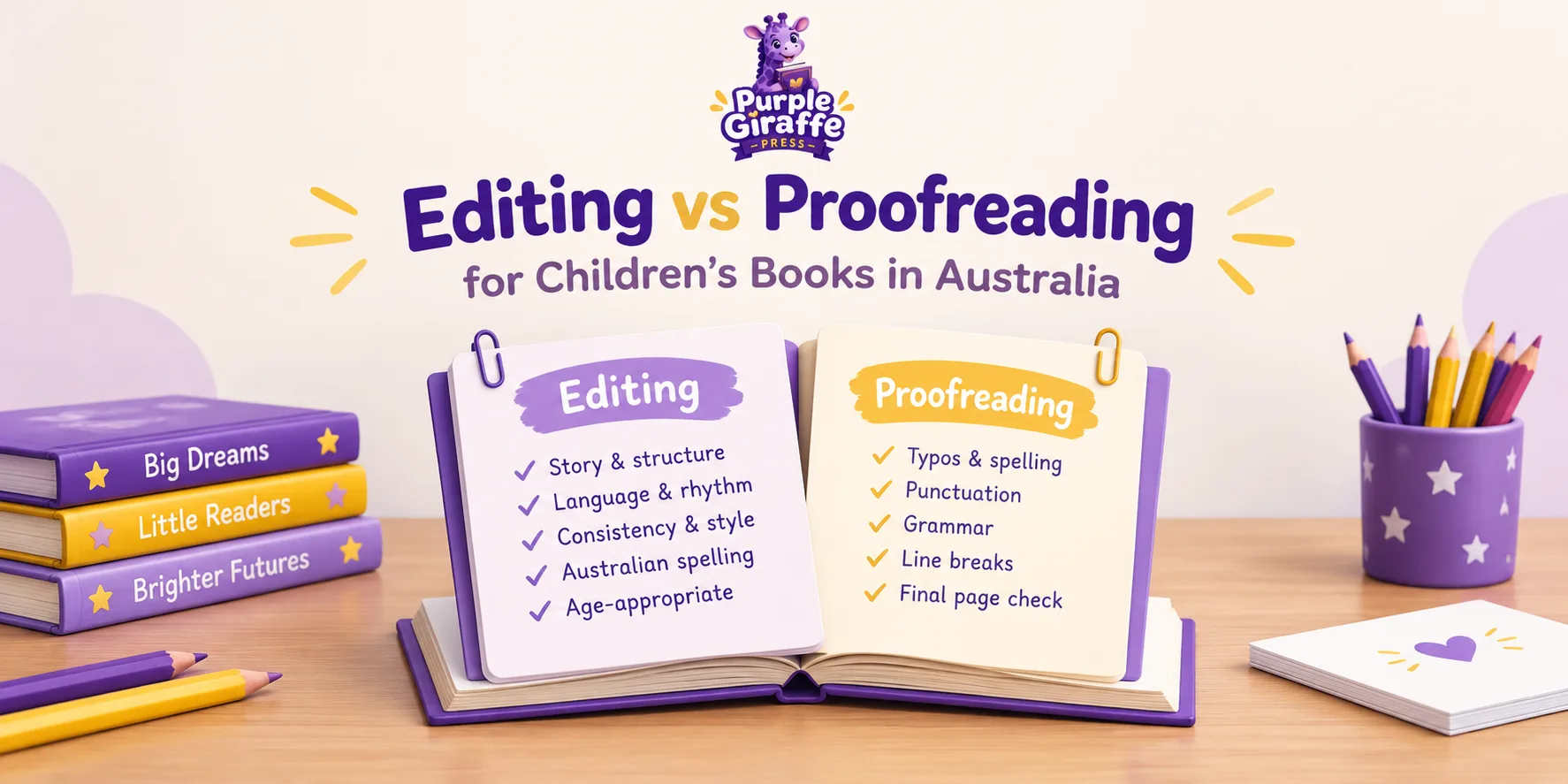
It's worth understanding the difference between editing and proofreading before you budget time for either, since authors often assume they're the same service. Our guide on editing versus proofreading for children's books explains where one stops and the other starts, and why skipping proofreading after editing is a common mistake. Our editing service covers the structural and line level work specifically.
A structural edit for a children's manuscript looks at things a copy edit never touches: whether the story's problem and resolution are clear enough for a young reader to follow, whether the pacing suits a read aloud format, whether the vocabulary matches the intended age group, and whether there's enough room on each page spread for illustration without the text feeling cramped. Skipping straight to a copy edit without this structural pass is one of the more common mistakes first time self-publishers make, since it catches surface errors while leaving deeper pacing or clarity problems untouched.
For a picture book manuscript, a single editing pass typically takes two to four weeks once an editor actually starts, though you'll often wait two to six weeks just to secure a slot with an experienced children's book editor, since most freelance editors in this space book out in advance. For a full length children's novel, expect four to eight weeks per editing pass, plus at least one round of author revisions in between, which can add another two to four weeks depending on how extensive the editor's notes are.
Even experienced editors flag the same small word mix ups again and again in children's manuscripts. A common one is the confusion between ingrained and engrained, a pair our editors catch often enough that we wrote a short explainer on ingrained versus engrained and which one is actually correct in modern usage.
Altogether, realistic editing (booking, the edit itself, and your revisions) runs from around six weeks on the fast end to roughly four months if you're doing two full passes on a novel length manuscript.
Finding and Working with an Illustrator
If you're writing a picture book, this is almost always the longest single stage in the entire process, and it's the one authors underestimate most often. Good children's book illustrators, particularly ones with experience preparing files to Australian printers' specifications, are often booked three to six months in advance, before a single piece of artwork is drawn. Because of that lead time, it's worth starting your search while your manuscript is still being edited rather than waiting until it's finished.
Once you've secured an illustrator and locked in a brief, the actual illustration work for a standard twenty four to thirty two page picture book generally takes two to five months, depending on the illustrator's style, how many revision rounds your contract includes, and whether the artwork is full colour spreads or simpler line work. Highly detailed, painterly styles sit at the longer end of that range. Simpler, more graphic styles tend to come in faster. Our custom illustrations service manages this entire pipeline, from brief through to final print ready files.
A big part of what makes an illustration brief effective is understanding how imagery actually functions in a children's book, not just as decoration but as a storytelling tool that carries meaning the text doesn't spell out. We cover this in more detail in what is imagery in a children's book, which is worth reading before you brief an illustrator, since a clearer brief tends to mean fewer revision rounds later.
Finding an illustrator in the first place is its own small project. Options range from dedicated children's book illustration agencies, to freelance marketplaces like Reedsy, to independent illustrators found through Instagram portfolios or word of mouth from other self-published authors. Agencies tend to have shorter waitlists but higher rates, since they manage a roster of artists and can usually slot you in faster. Independent illustrators are often more affordable but may have a single person's calendar to work around, which is exactly why the three to six month booking lead time matters so much. Whichever route you choose, ask to see a complete finished project, not just concept sketches, before signing a contract, since a portfolio of partial work rarely reflects how an illustrator handles the full print preparation process.
If you're self-publishing a novel with no interior illustrations and only a cover to commission, this stage shrinks considerably. A cover illustration and design typically takes two to six weeks from brief to final file.
Expert Tip: Lock in your illustrator before you finish editing, not after. The waitlist is almost always longer than the edit itself, and running both processes in parallel, editing while you wait for an illustration slot to open, is how experienced self-publishers avoid losing months to idle time.
Book Design and Layout
Once your text is final and your illustrations are in hand, a designer lays out the interior, placing text against artwork, choosing typefaces, and setting margins and spreads, while also finalising the cover. For a picture book, this involves close coordination with the illustrator's files and usually takes two to four weeks, plus time for you to review proofs and request adjustments. Our book formatting service handles interior layout for both picture books and text only novels, and book cover design covers the front and back cover separately, since cover design often runs on its own timeline alongside interior formatting.
For a text only children's novel, interior design is comparatively quick, usually one to three weeks, since there's no artwork to integrate, just consistent formatting, chapter headings, and front and back matter.
Build in an extra one to two weeks here for proofreading. This is the stage where a fresh set of eyes, ideally someone who hasn't read the manuscript a dozen times already, catches the typos and layout glitches everyone else missed. Our proofreading service is specifically positioned as this final check, separate from the earlier editing pass.
This is also the point where it's worth deciding on your final format, since it affects both design specifications and print timelines. Our comparison of hardback versus paperback for children's books walks through the practical differences, including how each format changes your printing lead time, which matters for the next stage.
Trim size matters here too. Most Australian picture books are designed to one of a handful of standard sizes, since non standard dimensions can add weeks to a print quote while a printer sources custom board or adjusts press settings. Settling on a standard trim size early, before your designer starts laying out spreads, avoids having to redo formatting work later if a printer can't accommodate an unusual size within your timeline.
Printing and Freight
Printing speed varies enormously depending on which method you choose, and this is where Australia's geography genuinely changes the equation compared to overseas guides. Our children's book printing service covers all three routes below and can advise on which suits your print run size and timeline.
Print on demand, through platforms like Amazon KDP, is the fastest option. Once your files are approved, a single proof copy can arrive within a week to ten days if printed and shipped within Australia, or two to four weeks if the proof is printed overseas and freighted in.
Local digital or short run printing through an Australian printer typically takes one to three weeks from approved files to delivered stock, since there's no international freight involved. This is often the best balance of speed and quality for small print runs of a few hundred copies.
Offset printing, usually the choice once you're ordering a thousand copies or more because the per unit cost drops significantly, is a different story if it's done overseas. The print run itself might only take one to two weeks once the press is running, but by the time you add pre press checks and ocean freight to Australia, total lead time commonly runs six to ten weeks, and can stretch past twelve weeks during peak shipping seasons.
How Book Type and Age Category Change the Timeline
Everything above assumes a standard picture book or a standard novel, but Australian self-publishers work across a much wider range of formats, and each one scales the timeline differently.
Board books, aimed at babies and toddlers roughly up to age three, usually run eight to twelve pages with very simple, bold illustrations and minimal text. Because there's less artwork and less manuscript to edit, board books can move through the entire process in as little as four to six months, making them one of the fastest formats to self-publish.
Picture books, the standard format for ages three to eight, typically run twenty four to thirty two pages with full colour illustrations on every spread. This is the format covered in most of the ranges above, and it's the slowest format relative to its length, purely because of the illustration workload.
Early readers and chapter books, aimed at newly independent readers roughly aged six to nine, sit in between. They usually include some illustration, often black and white line art rather than full colour spreads, spread more sparsely through the text. Because there's less artwork overall, the illustration stage tends to run six to ten weeks rather than the two to five months a full picture book needs, while the manuscript itself is longer than a picture book's, so editing takes a little more time.
Middle grade novels, aimed at readers roughly aged eight to twelve, are usually text only or include only a handful of spot illustrations at chapter openings. These follow the text only novel timeline below almost exactly, since there's no meaningful illustration pipeline to wait on.
Knowing which category your book falls into before you start is worth doing early, since it changes which stage of the timeline deserves the most buffer time.
Table 1: Self-Publishing Timeline by Stage (Australia)
Stage | Picture Book | Text-Only Novel |
Manuscript polishing (first draft to submission ready) | 2 weeks to 3 months | 3 to 6 months |
Professional editing (booking plus revisions) | 6 weeks to 3 months | 2 to 4 months |
Illustrator booking and artwork | 5 to 11 months (booking plus illustration) | Not applicable |
Cover design only | Included above | 2 to 6 weeks |
Interior design and proofing | 3 to 6 weeks | 2 to 5 weeks |
Printing: print on demand | 1 to 4 weeks | 1 to 4 weeks |
Printing: local short run | 1 to 3 weeks | 1 to 3 weeks |
Printing: offset, overseas with freight | 6 to 12 weeks | 6 to 12 weeks |
These ranges assume you're actively working through each stage without long idle gaps, and they shouldn't be added straight down the column for a grand total. In practice several stages overlap, which is why the month-by-month plan further down lands on a realistic eight to ten months for a picture book rather than the much longer figure you'd get from simply stacking every maximum on top of the other. Add buffer time if you're juggling this around a full time job, which most first time self-publishing authors are.
Choosing the Right Self-Publishing Route in Australia
Not every self-published book needs the same production setup, and the route you choose affects both your timeline and your budget. Broadly, Australian authors choose between print on demand, local short run printing, and overseas offset printing with a larger order size.
Print on demand suits authors testing the market or publishing a smaller personal project, since there's no upfront inventory cost and books print only as they sell. Local short run printing suits authors who want a few hundred copies on hand for a launch event, school visits, or local bookshop consignment, without the cost and complexity of an overseas order. Overseas offset printing suits authors planning a large initial run, typically a thousand copies or more, where the lower per unit cost justifies the longer freight timeline.
A fourth option, often overlooked, is running a hybrid approach: ordering a smaller offset run for a launch event and local stockists while keeping a print on demand listing live for ongoing online sales. This avoids the common trap of either running out of stock mid launch or paying to store boxes of unsold books, and it doesn't meaningfully complicate the timeline, since the two print methods can be set up in parallel once your files are finalised.
Beyond print, it's worth thinking about format diversity early rather than as an afterthought. Many children's books now exist alongside an audiobook version, which widens your audience without needing a second print run. Our audiobooks service produces narrated versions that can launch alongside or shortly after your printed book, and because audio production runs in parallel with the print process rather than after it, it doesn't meaningfully extend your overall timeline if you start it early. Once your book is printed, getting it into the right retail and library channels matters just as much as the printing itself, which is where a dedicated distribution service comes in, handling the retailer and library listings that most self-publishing authors don't have direct access to on their own.
Costs vary meaningfully depending on which market you're comparing against. If you're weighing up Australia against other English language markets, it's worth looking at what the same book would cost elsewhere: our breakdowns cover the cost of publishing a children's book in the UK, the cost to publish a children's book in Ireland, and the cost of publishing a children's book in the US, and they're a useful point of comparison if you're considering printing or distributing in more than one region.
Table 2: Comparing Self-Publishing Print Routes in Australia
Route | Typical Speed | Best For | Cost Per Unit |
Print on demand | 1 to 4 weeks | Testing demand, small or ongoing orders | Higher per copy |
Local short run printing | 1 to 3 weeks | Launch stock, local bookshops, school visits | Moderate |
Overseas offset printing | 6 to 12 weeks including freight | Large initial print runs (1,000+ copies) | Lowest per copy |
Expert Tip: If you're unsure which route to choose, start with print on demand for your first hundred sales. It's slower per unit cost but removes the risk of sitting on unsold stock while you're still working out demand.
A Realistic Month-by-Month Self-Publishing Timeline for Australian Authors
To make the stage by stage breakdown easier to plan against, here's what a typical self-publishing timeline looks like laid out month by month for a picture book, starting from a manuscript that's already had a couple of rounds of personal revision.
Months 1 to 2: Final manuscript polish and beta reader feedback. Start reaching out to illustrators now, ideally even before your manuscript is fully locked, since the three to six month booking window means outreach often needs to begin before the editing stage is finished.
Months 2 to 3: Professional editing. Submit your manuscript for a structural and copy edit, and use any waiting time to lock in your illustrator with a signed brief and contract.
Months 3 to 7: Illustration. This is your longest stretch, and it's largely out of your hands once the brief is approved, so use the time to plan your marketing and research printers.
Months 7 to 8: Interior design, cover finalisation, and proofing.
Months 8 to 9: Printing. If you're using print on demand or a local short run printer, this can compress significantly. If you're ordering an overseas offset run, build in the full freight window here.
Month 9 or later: Launch.
That puts a realistic total at around eight to ten months for a picture book, which sits comfortably inside the range in Table 1 once you account for the stages that run in parallel, and lines up with what you'd expect once you account for illustrator availability in the Australian market specifically.
A text only novel follows a shorter version of the same structure. Months one to three cover manuscript polishing and beta feedback. Months three to five cover professional editing and author revisions, running in parallel with cover design once a near final manuscript is ready. Month five to six covers interior formatting and proofreading. Month six onward covers printing, which for a text only novel using print on demand or local short run printing can be as quick as a few weeks, pushing total time to a printed book down to four to six months.
What Actually Slows an Australian Self-Publishing Timeline Down
Beyond the stage by stage estimates, a handful of factors specific to the Australian self-publishing environment consistently add weeks or months to a timeline that authors don't plan for.
Illustrator and editor availability. Australia has a smaller pool of children's book specialists than the US or UK market, which means popular freelancers book out further in advance relative to demand. Reaching out two to three months before you actually need a slot, rather than when you're ready to start, avoids a lot of wasted waiting.
ISBN and metadata registration. Every self-published book in Australia needs an ISBN, issued through Thorpe-Bowker, and accurate metadata matters for how discoverable your book is through retailers and library systems. This isn't usually a long process on its own, generally a few business days once you apply, but it needs to happen before you can list the book for sale, so it's easy to overlook until you're already behind schedule.
Overseas freight and customs. Any print run coming from an overseas offset printer is subject to shipping schedules and occasional customs delays that are completely outside your control. Peak periods around the lead up to Christmas, when everyone wants stock in before the holiday buying season, see printers and freight companies at their busiest, which pushes lead times toward the long end of the range.
Award and submission eligibility windows. If you're hoping your book will be eligible for recognition such as the CBCA Book of the Year awards, there are specific publication date windows that determine eligibility for a given year's awards cycle. If this matters to you, check current eligibility dates early, since they can effectively set a hard deadline for your print date that works backwards through the entire timeline.
Scope creep. A second illustrator revision round that wasn't in the original brief, a last minute decision to add a dedication page, a change to the trim size after design is already underway: each of these feels small in the moment and adds real weeks when they stack up.
Seasonal printer backlogs. Australian and overseas printers alike see demand spike in the lead up to the school year and again before Christmas, when both self-publishers and larger publishing houses are trying to get stock onto shelves at the same time. Booking your print slot a month or two earlier than you think you need to avoids getting queued behind everyone else with the same idea.
When to Start Marketing and Launch Planning
One of the most common timeline mistakes is treating marketing as something that starts after the book is printed. By then, you've lost months of lead time you can't get back.
Realistically, marketing should start the moment your manuscript goes to the editor, not when the box of printed books arrives. Building an author presence online is one of the first things worth setting up, since it takes time to grow an audience before you actually need one. Our author websites service builds this out early so it's ready well before your print date rather than thrown together in the final weeks.
A practical rule of thumb is to begin serious marketing and launch planning three to four months before your anticipated print date. That gives enough runway to organise a launch event, approach local bookshops and libraries, and build a pre order list. It also gives enough lead time to send advance reader copies to reviewers, teachers, or parenting networks, since early reviews posted close to your launch date carry far more weight than ones that trickle in months afterward. It's also enough time to put together promotional material with some actual thought behind it rather than scrambling once the books physically arrive, which is where a dedicated book promotion service earns its keep, coordinating the marketing push around your actual print date rather than reacting to it.
One format worth considering early, rather than as a last minute add on, is a short promotional video. Children's book trailers give parents, teachers, and librarians a quick sense of the story and artwork before they commit to buying, and because production can happen while your book is still in design or printing, it's one of the few marketing assets that doesn't need to wait for a finished physical copy.
Expert Tip: Lock in your print date range as early as possible, even as a rough window, and work your marketing calendar backwards from it. Trying to plan marketing around an unknown print date is one of the most common reasons launches feel rushed.
How Purple Giraffe Press Fits Into This Timeline
Everything above assumes you're coordinating editors, illustrators, designers, and printers yourself, which is entirely doable but is also, realistically, a part time project management job sitting on top of actually writing a book. This is where a publishing partner changes the picture, not by making the underlying stages shorter (editing still takes editing time, illustration still takes illustration time), but by removing the gaps between stages where most of the wasted time actually happens.
A coordinated children's book publishing service manages the handoffs: briefing the illustrator while the manuscript is still in edits, booking the designer before the artwork is fully finished so there's no dead time waiting for a slot, and managing the printer and freight timeline against a launch date set from the start rather than worked out as you go along. For Australian authors specifically, working with a team already familiar with local printers, freight realities, and ISBN registration tends to shave real weeks off a timeline that would otherwise be spent researching each of those steps from scratch.
Purple Giraffe Press works with authors across every stage covered in this guide, from manuscript support through illustration, design, printing, and promotion, with the specific goal of keeping the realistic timeline realistic rather than letting it drift the way self-managed projects often do. If you're weighing up whether to coordinate this process yourself or bring in that kind of support, it genuinely comes down to how much of your own time you want to spend project managing versus writing.
Choosing the right path also depends on the kind of book you're writing and the kind of support that suits it best. A heavily illustrated picture book benefits from a tightly managed illustration and design pipeline, while a text only novel benefits more from a strong editorial process and a well planned launch. Whichever route fits your project, the stages themselves don't change. What changes is how much of the coordination between them you want to carry yourself, and how much buffer time you build in for the parts of the Australian market, like freight and illustrator availability, that most generic guides never mention at all. Starting with a clear picture of where the real time goes, rather than a single borrowed number from an overseas article, is what actually makes a launch date achievable instead of aspirational.
Ready when you are
Let's bring your children's book to life.
From a first idea to a finished book children adore, we are with you at every step. Tell us about your story and we'll reply within one business day.
Start Publishing →